NATIONAL
120 Indian soldiers overpowered 2000 Chinese soldiers… How did Shaitan Singh's strategy defeat the enemy?

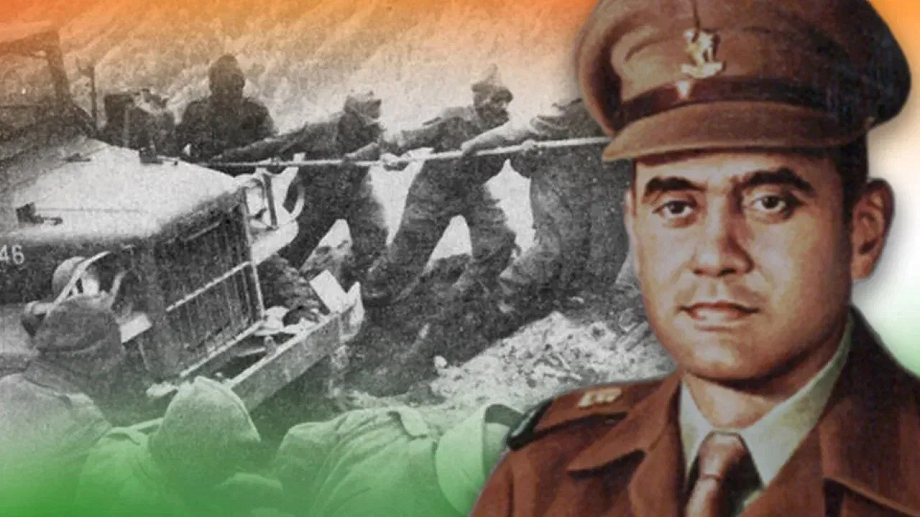
Major Shaitan Singh Bhati Death Anniversary: Major Shaitan Singh was a brave warrior who sacrificed his life in the lap of the Himalayas to ensure the nation's honor remained intact. During the 1962 India-China War, he faced approximately 2,000 Chinese soldiers along with 120 soldiers of the 13th Kumaon Battalion. Read the stories of Major Shaitan Singh on his death anniversary.
Major Shaitan Singh was martyred on November 18, 1962. Farhan Akhtar is playing the role of Major Shaitan Singh in the film 120 Bahadur based on him.
The date of November 18th commemorates the immortal heroes of the Indian Army who sacrificed their lives in the lap of the Himalayas to ensure the nation's honor remained intact. Major Shaitan Singh was a leading warrior among those brave soldiers who, along with 120 soldiers of the 13th Kumaon Battalion, faced approximately 2,000 Chinese troops during the 1962 India-China War.
Coincidentally, November 18 is his death anniversary and Farhan Akhtar's film 120 Bahadur, based on this incident, is releasing on November 21, which is an attempt to bring the bravery of those unsung heroes to the new generation.
Let's explore the life of Major Shaitan Singh, his military strategies, and the story of the remarkable Battle of Rezang La, which set an example of Indian courage in history. Even today, not only are the soldiers and officers of the Indian Army remembering him with pride, but the nation also pays homage to this brave son.
Journey from childhood to the battlefield
Shaitan Singh was born on December 1, 1924, into a Rajput family with a military heritage in Banasar, Jodhpur district, Rajasthan. From childhood, discipline, simplicity, and patriotism permeated his home. His father, also a military veteran, inspired him not by romantic fantasy but by stories of military life.
By the time he reached adulthood, Shaitan Singh's personality had crystallized. He was a man of few words, simple, yet possessed remarkable clarity when it came to decisions. Having grown up in a harsh environment, he cared little for adverse weather, hunger, thirst, or hardship. His dream was to serve his country in uniform, and that dream didn't last long. He joined the Indian Army and joined the Kumaon Regiment, the same regiment that would later make history at the Battle of Rezang La.
Identity of the Kumaon Regiment and Shaitan Singh
The Kumaon Regiment's ethos is one of deployment in difficult terrain and standing firm against the enemy. Major Shaitan Singh's reputation among the soldiers was that of an officer who set an example before giving orders. He lived with the soldiers in the same rigor, the same food, the same cold, and the same thorny climbs. During exercises, he himself walked in front, carried loads, took accurate aim at the firing range, and repeatedly reminded his soldiers that there was no room for weakness on the border. The enemy may be larger in numbers, but not in heart. Behind his calm demeanor lay a firm leadership. He neither made a fuss nor showed off, but when he made a decision, the entire platoon followed it as the ultimate truth.
The 1962 war with China, a brewing storm
In 1962, tensions between India and China were at their peak. Unclear border demarcation and political differences led to a confrontation between the armies of the two countries in high altitudes. Rezang La, a name that held strategic importance even then, was crucial. Located near the Chushul sector of Ladakh, this pass lies at an altitude of over 16,000 feet, making breathing challenging. Temperatures several degrees below zero, strong icy winds, a lack of oxygen, and a world of rocks and ice everywhere. It was here that C Company of the 13th Kumaon Battalion, commanded by Major Shaitan Singh, was deployed. Furthermore, resources were limited.
Heavy weapons were scarce, ammunition limited, and even wireless communication was completely unreliable. Despite all this, the Indian troops remained in high spirits. They knew that if the pass was breached, Chushul and the forward bases would be directly threatened.
One night at Rezang La when the enemy advanced stealthily
The night of November 18, 1962, was unusually quiet. The sky was dark, fine snow flakes lingered in the air, and the Chinese positions were faintly moving in the distance. Major Shaitan Singh knew this could be the calm before the storm. He gave his men a final review of their deployments, instructing them. Each platoon was ordered to position itself according to the rocks and escarpments. Clear plans were laid out for the fire field, i.e., the angles from which the enemy could be stopped.
The instructions were clear on how to calculate reserve ammunition and how to help each other in case of injuries. The Chinese army was nearly ten times larger in number. They also possessed mortars, heavy machine guns, and better communications. They planned to surround the Indian post, break through the rear to cut off supply lines, and open heavy fire from the front. The idea was to scare the 120 Indian soldiers into retreat or surrender.
Fewer soldiers but deadly barricades
Major Shaitan Singh's strategy was fundamentally based on the full utilization of the terrain. He positioned his units in such a way that the enemy would be in their crosshairs as soon as they climbed up. Indian soldiers, hidden behind rocks, waited for the enemy to approach, ensuring every shot was accurate. Despite their limited numbers, they divided their positions so that no matter which direction the enemy came from, they faced crossfire from one or another section. This somewhat neutralized the Chinese numerical advantage. In the dead of night, he ordered that they not fire unless they had a clear view. As a result, Indian counter-fire was extremely effective in the initial attack, and the Chinese army suffered heavy losses.
When 120 soldiers stopped 1200
Even before the first rays of dawn, the Chinese troops launched their attack. Mortar shells exploded on the snowy ground, and the blare of machine guns echoed. But as they advanced, C Company of the 13th Kumaon was awakened. Rifle and machine gun fire rained down from the positions. Many Chinese soldiers were killed in the enemy's first attack.
The Chinese army had assumed that the Indian soldiers, battling the altitude and cold, would not hold out for long, but the reality turned out to be the opposite. The Chinese troops repeatedly attempted infiltration from multiple directions. Sometimes from the left, sometimes from the right, sometimes from the rear, taking a circuitous climb. Each time, Major Shaitan Singh would shift his and other sections' positions and lead the fire. He would run from front to front across the open field, boosting the soldiers' morale, correcting the direction of fire, and even when wounded, refusing to retreat.
His comrades often advised him to take cover behind the rocks, but his answer was clear: "How can the soldiers fight if the commander is behind?" The battle continued for several hours. Despite the cold, fatigue, and injuries, the Indian soldiers held their ground. Gradually, ammunition began to dwindle. In some sections, the situation became so dire that soldiers resorted to attacking the enemy with the knives attached to their guns. Many soldiers remained in their positions until their last breath, their bodies later found in the same posture in which they had fallen, as if even death could not bend the direction of their weapons.
The immortal martyrdom of Major Shaitan Singh
During a fierce battle, Major Shaitan Singh was hit by enemy machine gun fire and seriously wounded. His comrades wanted to carry him to safety. Legendary but well-documented, history has it that he urged his comrades to place him in a position where enemy activity could be observed, allowing his fellow soldiers to return to the front and continue the fight. He was unwilling to retreat and see his men's morale broken.
Ultimately, they gave up their lives on the very snow-covered land they fought for. Months after the battle ended, the Indian Army recaptured the area and, as the snow melted, launched a search operation. Major Shaitan Singh's body was found, still with his weapon in the same position, as if he had been commanding until his last breath. The bodies of his fellow soldiers were also found around him, still in fighting positions. This scene of 120 soldiers holding off 1,200 enemies for hours, is forever etched in the minds of all who witnessed it.
Param Vir Chakra and immortal legacy
Major Shaitan Singh was posthumously awarded India's highest military decoration, the Param Vir Chakra. This honor was not only for his individual valor, but also for the collective courage and unwavering leadership that inflicted heavy losses on the enemy in a seemingly impossible battle and defended a strategically important area. The Battle of Rezang La is still taught in military academies as an example of how, despite limited resources, harsh weather, and a massive numerical disadvantage, history can be changed through sound leadership, strategic vision, and morale.
Importance of the film 120 Bahadur
Farhan Akhtar's film 120 Bahadur is releasing on November 21st. It's not just a film, but a medium of remembrance and gratitude. The power of cinema is to bring to the public even stories that are often confined to history books. This film will bring to a new generation the saga of those 120 soldiers, whom many young people may not even know by name. It will demonstrate that sacrificing one's life for the country is not just a phrase, but a real-life decision where life and death are decided in a split second. It will bring to life the sacrifice of Major Shaitan Singh and his comrades in visual form, so that every viewer will feel the question: what would they have done if they had been there?
PC:TV9Bharatvarsh