For years, the artificial intelligence revolution lived entirely behind digital screens. We chatted with bots, generated images, and let software write code. But the technology landscape has hit a massive inflection point.
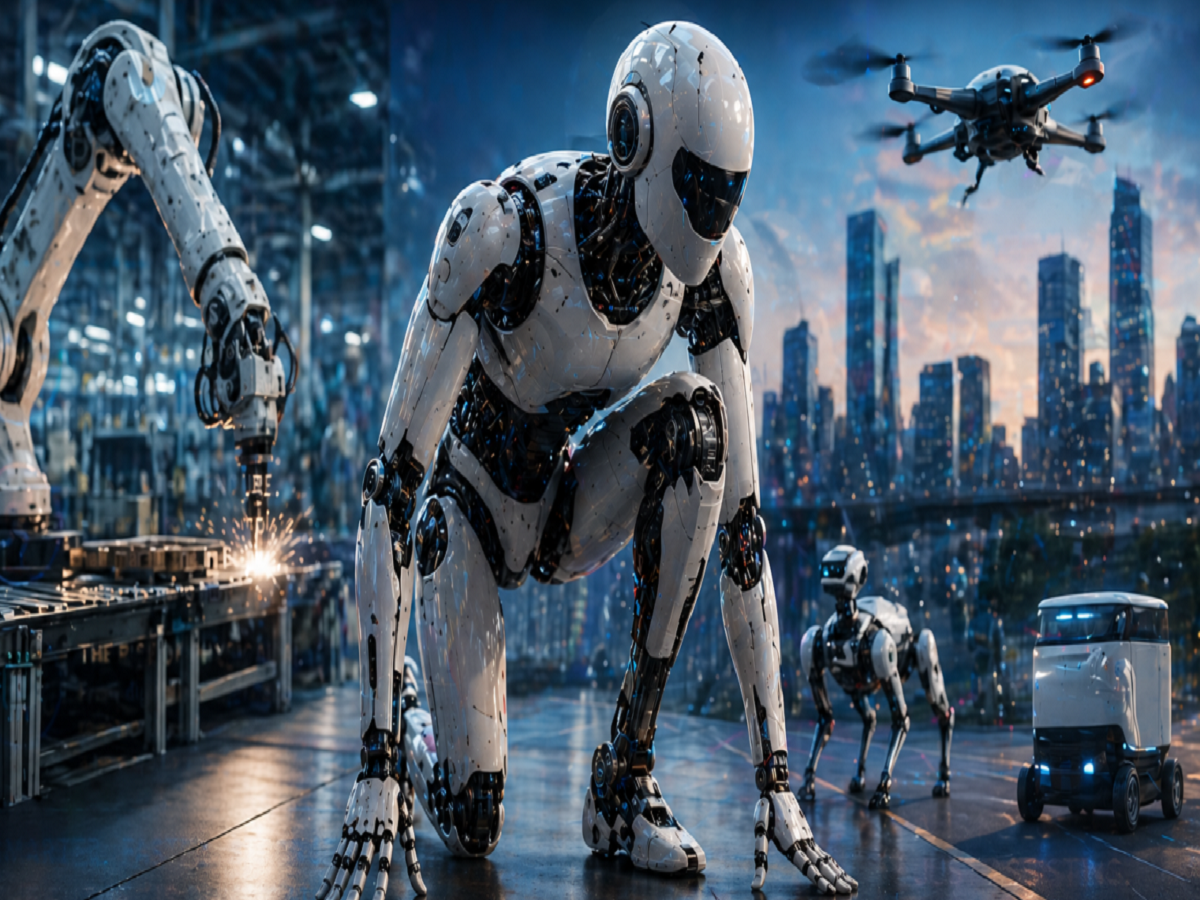
The focus of global tech giants like Nvidia, Amazon, and Tesla has officially pivoted toward Physical AI—the integration of advanced large language models with real-world robotics and spatial hardware. Powered by brain-inspired chips and real-time physics simulators, intelligence is breaking out of the phone app and entering physical space.
Here are the three foundational pillars driving this real-world hardware transition.
1. "Physics Intuition" via World Foundation Models
Historically, programming a robot to do something as simple as pouring a glass of water required thousands of lines of precise, rigid code. If the cup moved an inch, or the water splashed slightly, the system glitched because it didn't actually "understand" gravity or fluid dynamics.
The breakthrough solving this is the emergence of World Foundation Models (such as Nvidia's Cosmos architecture).
Rather than following hardcoded rules, these models act as internal neural physics simulators. The AI looks at the environment via camera arrays and accurately predicts how physical states change—understanding how objects bounce, bend, roll, or spill before it even touches them. This gives machinery a form of artificial common sense.
2. Low-Wattage Edge Accelerators (The Blackwell Brain)
Running massive AI models used to require thousands of pounds of server racks humming inside temperature-controlled data centers. You couldn't exactly strap a supercomputer onto a delivery drone or a factory arm.
The hardware game completely changed with specialized Edge NPU Modules.
| Chip Architecture Generation | AI Processing Power | Power Consumption | Operational Dependency |
| Legacy Legacy Mobile Chips | ~10-40 TFLOPS | 5W - 15W | Heavy reliance on cloud server data streaming. |
| Next-Gen Edge Hardware (e.g., Jetson T4000) | 1200+ TFLOPS | 40W - 70W | 100% Local Operations (Zero lag, zero cloud connection needed). |
This massive density jump allows robots to run concurrent vision encoders and spatial reasoning systems entirely on local battery power, keeping processing instantaneous and completely offline.
3. The Sudden Rise of the Agentic Workforce
We are rapidly moving from an economy of "Generative AI" (software that creates content) to an Agentic Economy (software that independently executes multi-step real-world tasks).
Physical AI agents are now breaking out of pilot programs and entering commercial production lines:
-
Logistics Sorting: Companies like Amazon have surpassed a million deployed fulfillment units, using centralized agent fleets that dynamically recalculate physical warehouse travel paths to optimize spatial layout.
-
Autonomous Automotive Assemblers: Automakers are testing vehicles that completely drive themselves through the factory assembly line stages, mapping out their own quality-check coordinates without human oversight.
Checklist: Navigating Your First Smart Connected Wearable
As Physical AI advances, the industry is subtly shifting away from smartphone screens toward ambient, screen-free wearables like smart glasses and sensory earpieces. If you are picking up an AI-native spatial device, keep this optimization checklist in mind: