AUTO
No Power Grid, No Problem! BYD Unveils Solar-Powered EV Charging Station in Abu Dhabi With a Robotic Arm
Electric vehicles are rapidly gaining popularity as people look for alternatives to petrol and diesel-powered vehicles. However, one major concern continues to affect potential EV buyers: charging infrastructure. Finding a fast-charging station, particularly in remote locations with limited electricity supply, can be challenging.
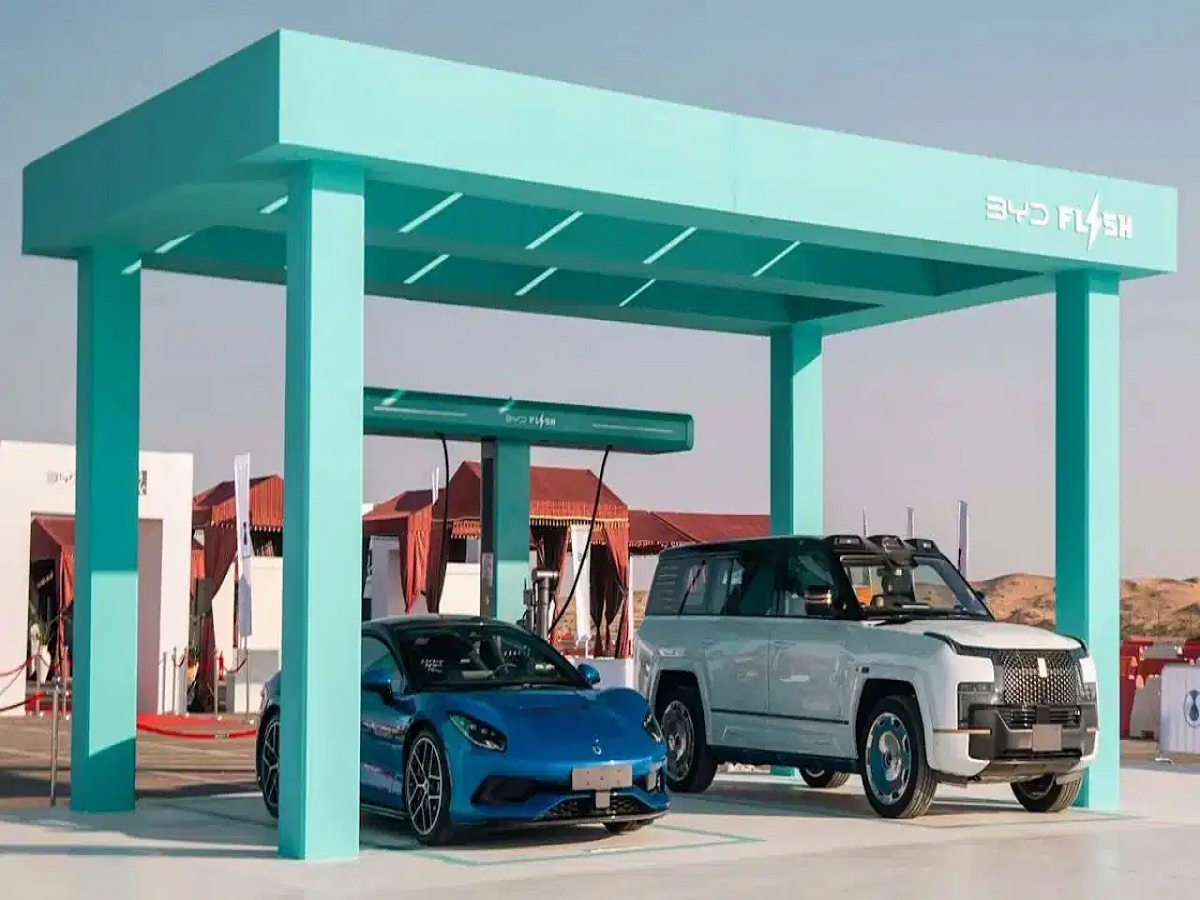
Addressing this concern, Chinese automobile manufacturer BYD has introduced an innovative electric vehicle charging station in the desert of Abu Dhabi. The system combines solar energy, battery storage and ultra-fast charging technology to provide electricity to electric vehicles, even in locations where conventional power infrastructure may be unavailable.
But that's not all. The charging station also features a robotic arm that automatically connects the charging plug to the vehicle, making the charging process more convenient.
How Does BYD's New Charging Station Work?
BYD's innovative charging system operates using three major components: solar panels, battery storage and a high-power flash charger.
The solar panels capture sunlight and convert it into electricity, which is then stored in large battery units. This stored energy is subsequently used to charge electric vehicles.
The biggest advantage of this technology is that the charging station is designed to operate without depending directly on the electricity grid. This could make it particularly useful in remote areas, deserts and locations where establishing conventional charging infrastructure is difficult.
The automated robotic arm further simplifies the process by connecting the charging cable to the vehicle.
370 kWh Battery Capacity Powers the Charging Station
One of the most impressive features of BYD's new charging infrastructure is its substantial battery storage capacity.
The station uses T-shaped flash chargers, with each charger connected to two energy storage batteries, each offering a capacity of 185 kWh. Together, they provide a total storage capacity of 370 kWh per charger.
According to the company, the system can draw power at approximately 100 kW to 560 kW, depending on the configuration, while delivering significantly higher output to compatible electric vehicles.
The charger can provide up to 1,500 kW of power through a single charging cable. When both cables are used simultaneously, the maximum output is up to 1,000 kW.
This high-power charging technology could significantly reduce the time required to recharge compatible electric vehicles.
10% to 70% Charging in Just 5 Minutes!
Charging speed is perhaps the most exciting aspect of BYD's latest technology.
The company's new 1,500 kW flash charger is designed to work with electric vehicles equipped with its second-generation Blade Battery.
According to BYD, the technology can charge a compatible vehicle's battery from 10% to 70% in just five minutes. The company further claims that charging can reach 97% in approximately nine minutes.
However, these charging speeds are not available for every electric vehicle. Only models equipped with compatible battery technology and charging systems can benefit from the full capabilities of the charger.
If these claimed speeds can be achieved consistently under suitable conditions, the technology could make EV charging considerably more convenient.
What Makes Battery-Powered Charging Stations Important?
BYD is not the only company exploring battery-supported electric vehicle charging infrastructure. Several companies, including Tesla, Electric Era and Beam Global, are also developing technologies in this area.
Such charging systems can store electricity and release it when vehicles need to be charged. This can help reduce sudden demand on the electricity grid, particularly during peak hours.
Solar-powered battery storage systems could also make it easier to establish charging facilities in remote locations without depending entirely on conventional power infrastructure.
What Details Are Still Awaited?
Despite the impressive technology, several important details about BYD's new charging station are yet to be clarified.
The company has not fully disclosed how much electricity its installed solar panels can generate or how many electric vehicles the station can charge daily using solar energy alone.
There are also questions about how long the charging facility can operate independently without grid connectivity and how its energy storage system will be replenished.
These details will be important in determining the technology's long-term efficiency, practicality and suitability for large-scale deployment.
The Bottom Line
BYD's new solar-powered charging station represents an interesting development in the electric vehicle industry. By combining renewable energy, large-scale battery storage, ultra-fast charging and robotic automation, the company is exploring new possibilities for EV infrastructure.
If the technology proves practical and commercially scalable, it could help expand charging facilities in remote areas where conventional electricity infrastructure is difficult to establish.
With charging speeds measured in minutes and the possibility of operating away from traditional power grids, BYD's innovation could offer a glimpse into the future of electric vehicle charging.