NATIONAL
Chenab Bridge: Unaffected by anything from a 266 KMPH storm to earthquakes and explosions, know what else is special about Chenab Bridge..
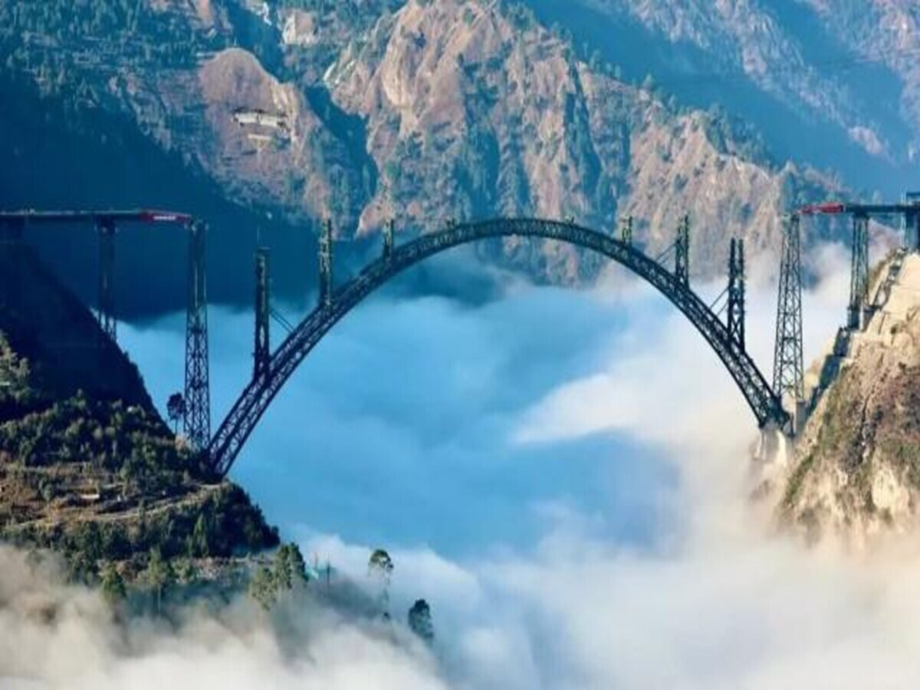
Prime Minister Narendra Modi will be in Jammu and Kashmir on Friday. He will inaugurate the Chenab Railway Bridge, which is considered to be the most important stop of the 272 km long Udhampur-Srinagar-Baramulla railway link. This bridge, which is only 1315 meters long, is the most difficult and time-consuming part of the project. It took 22 years from the decision to build this bridge to its inauguration.
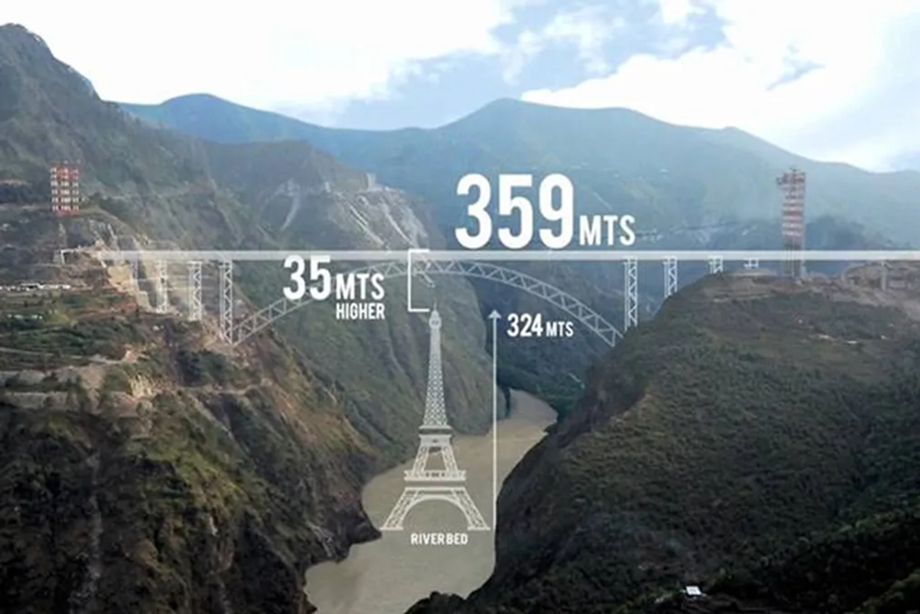
Why did the Chenab Bridge take so long to be built? What are its specialties? What is the history of railways in Jammu and Kashmir? Why does India need this bridge and how will it put the country in a strong position diplomatically? Let's find out...
How did the railway connection of the Jammu and Kashmir valley remain stuck for years due to an arch bridge?
1897: The first railway line in Jammu and Kashmir was laid on the 40-45 km plain route from Jammu to Sialkot.
1947: After the partition, Sialkot went to Pakistan. For the next 28 years, Jammu remained connected to the rest of the country only by road.
1975: The railway line connecting Jammu to Pathankot in Punjab was inaugurated.
1983: The 53 km long railway line project between Jammu and Udhampur started. The estimated cost of this was Rs 50 crore.
1994: The extension of the Jammu-Udhampur railway line to Srinagar and then Baramulla was announced.
1995: The Udhampur-Srinagar-Baramulla railway line project was approved in March. At that time, its estimated cost was Rs 2500 crore.
2004: The Jammu-Udhampur project approved in 1983 was completed 16 years after its scheduled time. It cost 515 crores, 10 times more than the estimated 50 crores. Under this project, 20 big tunnels were constructed through the mountains. The biggest tunnel among these is 2.5 km long. Apart from this, there are 158 bridges on the route, the highest of which is 77 meters high. In the year 20025 itself, instructions were given to complete the Udhampur-Srinagar-Baramulla railway line project soon. Given the difficulty of this project, it got the status of a national project.
Till recently, the cost of the project has exceeded 35 thousand crores. Of this, about Rs 1500 crore has been spent only on building the Chenab railway bridge between Bakkal and Kauri.
Now know - why is there a need for a bridge on the Chenab river in Jammu and Kashmir?
Before knowing about the Chenab bridge, know why is this bridge built in Jammu and Kashmir needed? So the answer to this is that the system of Indian Railways was limited to the Jammu region of the Union Territory till the construction of this bridge. That is, if you book train tickets, you will find that trains going to Jammu and Kashmir do not provide the facility to go to the capital Srinagar, but only to Jammu Tawi. After this, people have to cover a distance of 350 km by road to Srinagar (Kashmir Valley). In winter, there is a danger of this route getting closed after snowfall, due to which either one has to wait for the weather to improve to reach Kashmir or one has to take the help of an air route from any city in India.
A big challenge in this entire project was the construction of a bridge over the Chenab River in Reasi. Reason- Chenab River flows between the mountains in a trench-like path, over which building a bridge was a difficult task.
What are the specialties of Chenab Railway Bridge?
It has taken two decades to build the Chenab Railway Bridge, however, after its opening, a direct rail link will be made between Kashmir Valley and Jammu. This will be the first time that people will be able to go directly from Kanyakumari to Kashmir Valley.
Which technology was used to build the bridge?
According to a website named Railway Technology, the roads in the hilly region of Jammu and Kashmir are narrow in some places and winding in others. Meanwhile, there are many ditches and plains. The ditch in which the Chenab River is located between the mountains is very deep. Usually, cantilever technology, suspension bridge technology, or cable bridge technology is used to build bridges. But considering the land around Chenab, it was decided to build the bridge on the lines of a steel arch design.
This bridge was designed by the Canadian company WSP. This bridge has been erected on 17 steel pillars, which are installed on an arch iron base. This arch rests on the hills on either side of Chenab river and it is adjacent to the middle of the bridge with a radius of 469 meters. The rest of the radius is installed on the pillars only. To build it, cable cranes working up to a height of 3000 feet were installed on both sides of the Chenab River. It was through these cranes that steel was used in a phased manner to build the bridge in the middle of the hill.
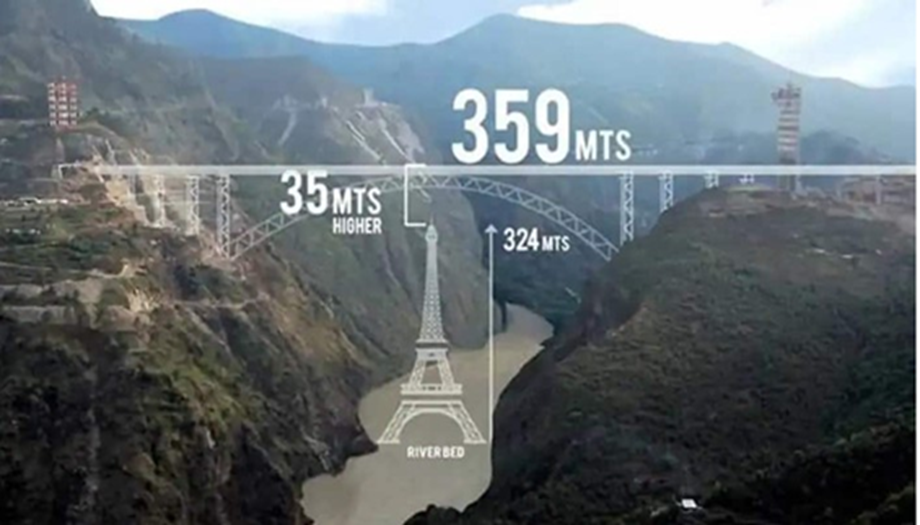
Germany to South Korea involved in the construction of the Chenab Bridge.
Apart from WSP, Germany's Leonhart Andra was also involved as a consultant for this project. Apart from this, Konkan Railway took the responsibility of building the bridge. In this, India's VSL was also involved in the joint venture with AFCONS Infrastructure, Ultra Construction, and South Korea's engineering company.
PC Social media