There are some temples in India where men are prohibited from entering during specific rituals. These include the Maa Kamakhya Temple and the Attukal Bhagavathy Temple. Learn about six such temples.
"Yatra Naryastu Pujyante Ramante Tatra Devtaah."
It is said in the scriptures that where women are respected, God resides there.
Whenever we talk about temple entry in India, the debate usually goes in one direction. We hear about the restrictions imposed on women. We hear about court cases. We talk about equality versus tradition.
But there's another side to this story that's rarely talked about. Did you know that there are some temples in India where men are not allowed into certain areas, and in some cases, they're not allowed in at all during specific rituals?
You won't see any protests outside these temples, not even any viral hashtags, but there are known rules that everyone respects and follows without protest.
Attukal Bhagavathy Temple, Kerala
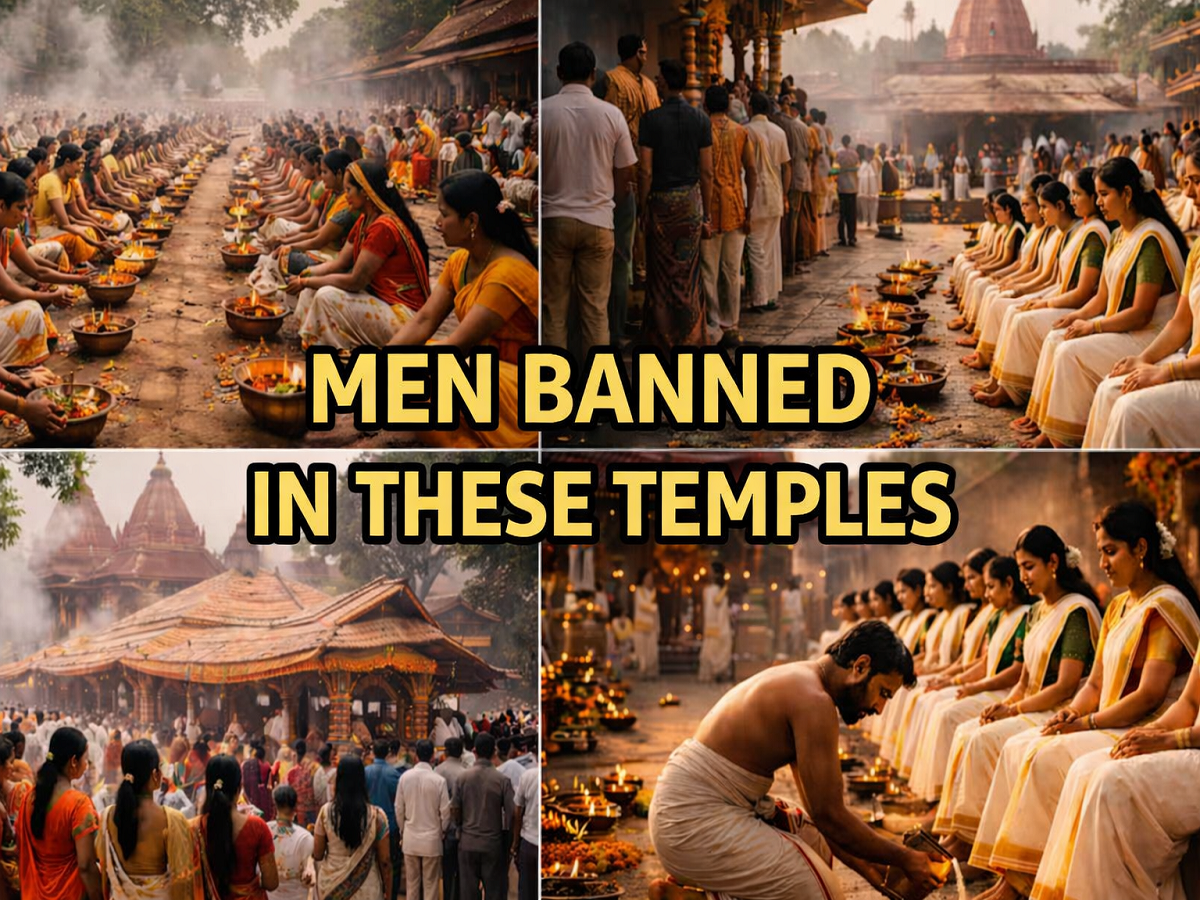
Attukal Bhagavathy Temple, located in Kerala, is commonly known as the Sabarimala of women. During the famous Attukal Pongal festival, millions of women gather to offer offerings to the goddess. The streets are transformed into sacred kitchens, with fires burning in unison. During this time, millions of women devotees gather here.
Men step aside during this ritual. The reason is symbolic. The Goddess is worshipped in her fierce and protective form, and this ritual is designed as a collective expression of feminine energy. Men are not excluded from the temple out of hostility, but rather, they are not part of this particular spiritual expression. For those few hours, the space belongs exclusively to women.
Chakkulathukavu Temple, Kerala
A unique event occurs every year at the Chakkulathukavu Temple in Kerala. During the Nari Puja, women are worshipped as embodiments of the Goddess. The chief priest symbolically washes the feet of female devotees.
This ritual reverses the traditional power structure. Generally, men have more authority than women in society. However, here, women take center stage. They are not only worshippers, but also worshipped as goddesses.
Brahma Temple, Pushkar, Rajasthan
The Brahma Temple is located in Pushkar, Rajasthan. Although men can also visit this temple, married men are not permitted to worship at certain places of worship. There is a mythological story behind this.
According to a legend associated with the temple, Goddess Saraswati became enraged during a yagna performed by Brahma. This legend led to a complete ban on married men performing certain rituals at the temple. This rule has remained in place for centuries.
Maa Kamakhya Temple, Assam
The Maa Kamakhya Temple in Assam is one of the most powerful shrines in India. The Goddess is worshipped here not in human form, but in the form of a natural stone structure representing the feminine womb.
Every year, the temple is closed for three days during the Ambubachi Mela. This period symbolizes the goddess's menstrual cycle. Upon reopening, devotees celebrate the fertility and creative power of nature.
Although there is no permanent male restriction, the ritual is deeply focused on the female creation and sacred fertility. The message is powerful. In a society where menstruation is often considered a stigma, this temple considers it sacred.
Santoshi Mata Temple, Vrindavan
Santoshi Mata Temple, Vrindavan: Women perform ritualistic functions in local temples. Men are not allowed to enter the sanctum sanctorum on certain days.
Santoshi Mata is widely worshipped by women who observe Friday fasts for the well-being and prosperity of their families. This prohibition is rooted in a devotional culture rather than a formal prohibition.
Bhagavathi Temple, Tamil Nadu
Some Bhagavathi temples in Tamil Nadu, South India, have rituals where men are not allowed into the sanctum sanctorum during certain ceremonies. The goddess is worshipped as a virgin goddess, symbolizing purity, independence, and self-reliant power.
These boundaries reinforce the symbolic identity of the goddess. This does not mean, of course, that humans are impure. Rather, the ritual represents a sacred pledge or state of the goddess.
Disclaimer: The information provided here is based solely on beliefs and information. It's important to note that News Crab does not endorse any beliefs or information. Consult a relevant expert before acting on any information or information.