BUSINESS
Government’s Big Waste-to-Energy Push: New ₹23,731 Crore Scheme Could Turn Farm and Kitchen Waste Into Fuel
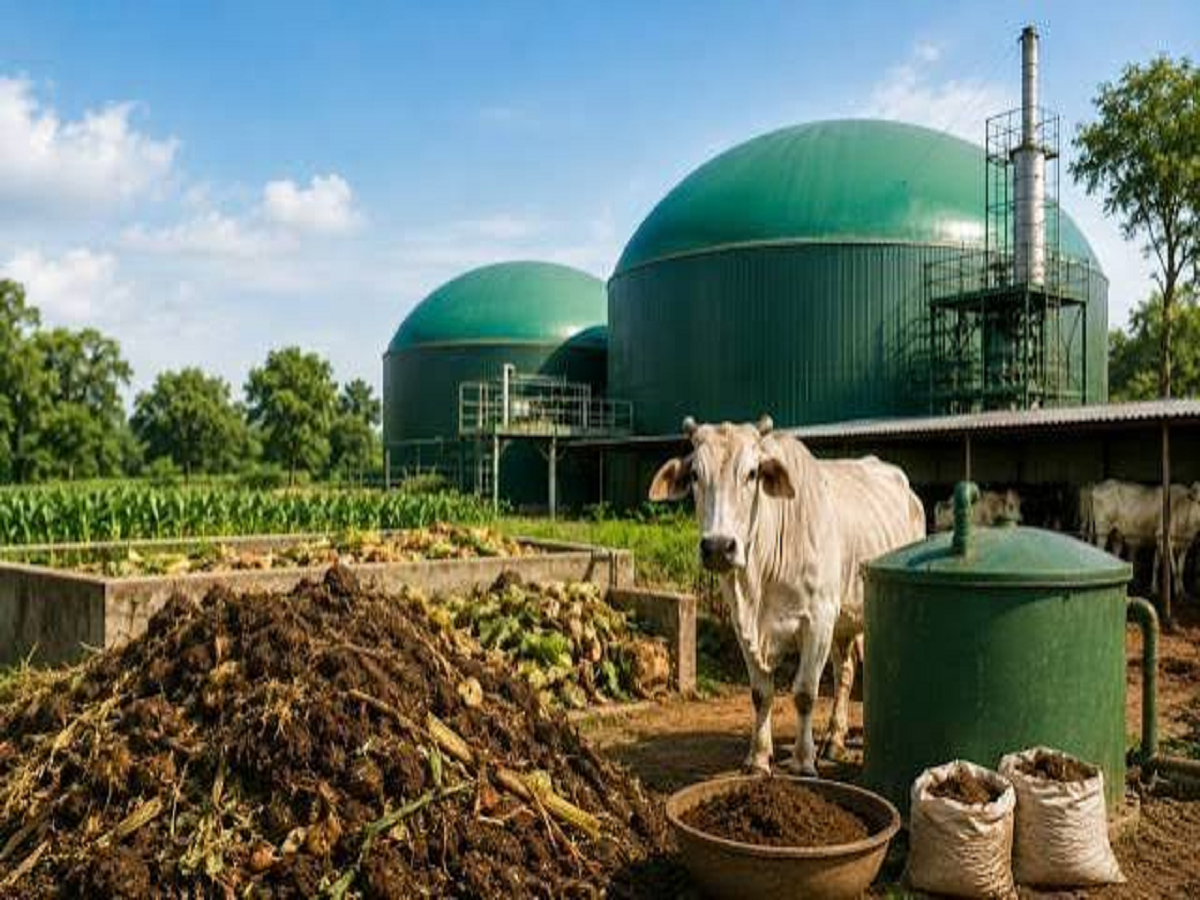
The government has approved a major new initiative aimed at turning agricultural waste, animal waste and other organic waste into useful energy. The revamped GOBARdhan scheme will operate from financial year 2026-27 to 2035-36, with a total outlay of ₹23,731 crore.
The programme is designed to expand the production of Compressed Biogas (CBG) across the country and could create new opportunities for farmers, rural communities and businesses involved in waste management.
What Is the GOBARdhan Scheme?
GOBARdhan, which stands for Galvanizing Organic Bio-Agro Resources Dhan, was originally launched in 2018 to promote the conversion of organic waste into biogas and bio-slurry.
Under the revamped framework, the government wants to make CBG a more important part of India's energy mix. The scheme brings different components of the CBG ecosystem together under the Ministry of Petroleum and Natural Gas.
What Kind of Waste Can Be Used?
The programme focuses on different forms of organic waste, including:
-
Animal waste
-
Crop residue
-
Kitchen waste
-
Market waste
-
Other biodegradable agricultural waste
Instead of allowing this waste to become a disposal problem, it can be processed to produce biogas and eventually Compressed Biogas.
What Is Compressed Biogas?
Compressed Biogas is produced by processing organic material through anaerobic digestion and then purifying the resulting biogas.
The resulting fuel can be used in applications similar to conventional compressed natural gas, depending on the required specifications and infrastructure.
This creates an opportunity to turn locally available waste into a useful energy resource.
Government Targets Nearly Tenfold Growth
One of the major objectives of the revamped scheme is to increase domestic CBG production by nearly ten times.
The government also wants to attract large-scale private investment and develop what it describes as a circular bioeconomy, where waste generated by one activity becomes a resource for another.
How Could Farmers Benefit?
Agricultural residue and animal waste can become valuable raw materials for CBG plants.
The government's approach is intended to create additional economic opportunities around the collection, transportation and processing of biomass. It could also provide farmers and rural communities with another potential avenue for monetising agricultural and animal waste.
The broader objective is to make villages participants in clean-energy production rather than simply consumers of energy.
Support for CBG Projects
The scheme includes several forms of support designed to strengthen the CBG ecosystem.
These include assured demand, stable and remunerative pricing mechanisms, capital assistance, pipeline infrastructure, credit guarantees and technology development.
The government is also continuing initiatives supporting biomass aggregation and infrastructure needed to transport CBG from production facilities to markets.
What Does This Mean for Ordinary Consumers?
The scheme does not mean that households will immediately receive free fuel or direct cash benefits.
Its impact is expected to develop gradually as more CBG plants are established and production increases. Greater use of domestic bioenergy could eventually help diversify India's fuel supply while reducing dependence on conventional fossil fuels.
For households and farmers, the most visible benefits may come through improved waste management, new rural economic activity and the gradual development of local clean-energy infrastructure.
Why Is This Scheme Important?
The GOBARdhan expansion connects waste management, agriculture and energy production in one framework.
Instead of treating crop residue, animal waste and organic waste simply as something that needs to be discarded, the government is attempting to turn it into a source of fuel and economic value.
With a ₹23,731 crore outlay and an implementation period extending to 2035-36, the scheme represents a long-term push to make waste-based energy a larger part of India's energy system.