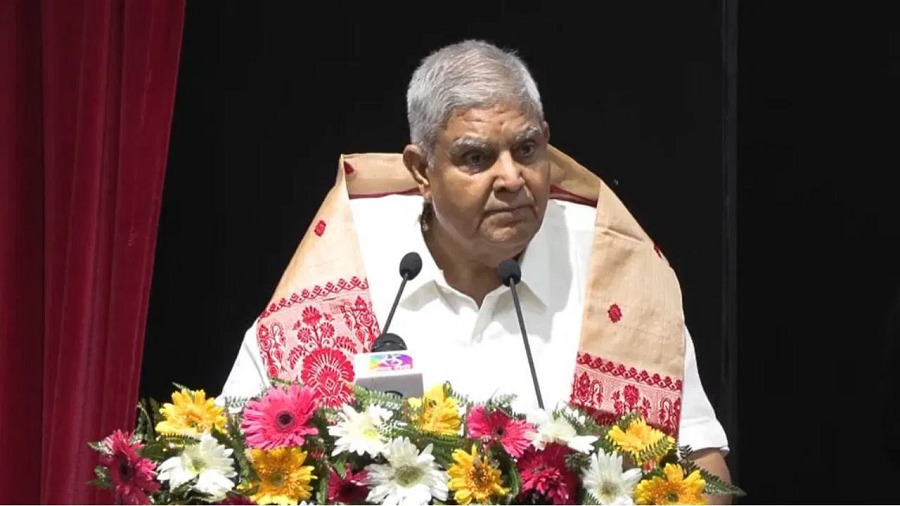
Vice President Jagdeep Dhankhar, speaking at the first Annual Conference on Indian Knowledge Systems (IKS) in New Delhi, emphasized that India's rise as a global power must be rooted not just in political and economic terms, but also in intellectual and cultural dignity. He asserted that the strength of any nation lies in the originality of its thinking, the timelessness of its values, and its robust intellectual traditions—qualities that form India's enduring soft power.
India: More Than a Nation, a Civilization
Dhankhar rejected the colonial notion of India as merely a political construct of the 20th century. Instead, he described India as a "flowing river of consciousness, curiosity and knowledge." He called for dismantling the colonial mindset that still lingers post-Independence, which often dismissed indigenous knowledge as primitive while elevating Western perspectives as universal truths.
Two Disruptions in India’s Intellectual History
He pinpointed two major disruptions in India’s intellectual tradition:
-
The Islamic invasions, which, according to him, disrupted inclusivity in learning and replaced it with destruction.
-
British colonialism, which transformed India’s centers of learning into institutions producing ‘brown babus’ rather than independent thinkers.
“The land of sages,” he remarked, “was turned into a land of clerks.” This, he said, led to a culture where rote learning replaced reflective thinking, severely damaging India's ancient learning traditions.
India’s Ancient Universities: Global Centers of Knowledge
He invoked the glory of India’s historical universities—Nalanda, Takshashila, Vikramshila, and others—as ancient global hubs of education. These institutions, Dhankhar said, attracted scholars from Korea, China, Persia, and Tibet and were home to vast libraries of wisdom. “When Europe had no universities, India’s learning centers were beacons of knowledge,” he noted.
Tradition and Innovation Must Go Hand in Hand
Vice President Dhankhar stressed that ancient wisdom and modern innovation are not in conflict. “Spirituality and scientificity can go together—but only when spirituality is properly understood.” He cited examples like the Rig Veda's cosmological mantras being relevant in modern astrophysics, and the Charaka Samhita contributing to current global public health ethics debates.
Call for Digitization and Research Training
Highlighting the urgency for action, Dhankhar urged for immediate digitization of classical texts in Sanskrit, Tamil, Pali, and Prakrit to make them widely accessible. He also emphasized the need for research training in philosophy, comparative studies, and sciences to empower the youth in rediscovering India’s intellectual heritage.
India’s Knowledge as a Global Solution
In conclusion, Dhankhar remarked that in a world fractured by conflict and division, India’s knowledge systems—steeped in reflections on soul and matter, duty and consequence—could offer inclusive and long-term solutions. He urged India to reclaim its narrative, not through nostalgia, but through revival and application of its ancient wisdom in contemporary contexts.
Ask ChatGPT