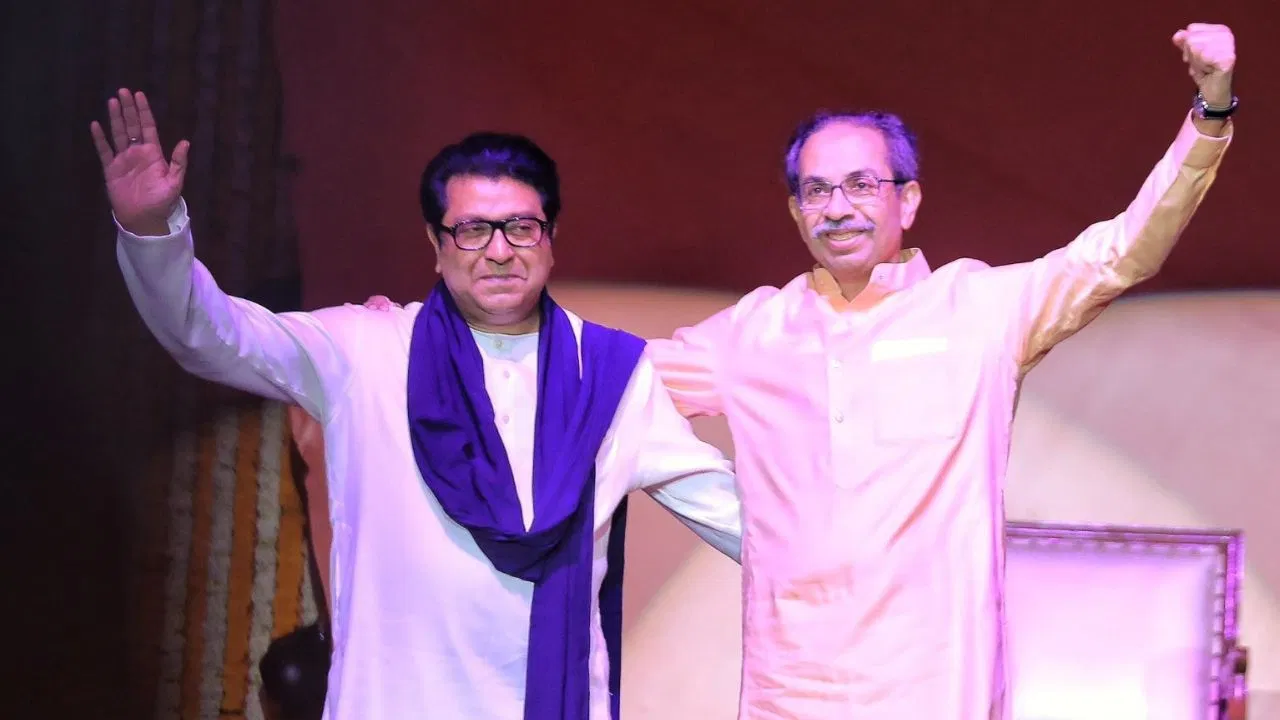
The date 5th July 2025 may go down as a historic moment in Maharashtra’s political timeline. For the first time in nearly two decades, Raj Thackeray and Uddhav Thackeray, once close relatives and now long-time political rivals, appeared together on the same stage at Mumbai's Dome Auditorium in Worli. The event, organized to celebrate the cancellation of a controversial state order on Marathi language in primary education, drew a massive crowd of over 30,000 people—but its implications stretch far beyond just education policy.
The Significance of the Reunion
While the official purpose of the event was cultural, the underlying message was clearly political. The shared stage signaled not just reconciliation, but a potential political alliance between two factions that once formed the core of a united Shiv Sena before Raj broke away in 2006 to form the Maharashtra Navnirman Sena (MNS).
Now, after both Raj and Uddhav suffered heavy setbacks in the 2024 Lok Sabha elections, the symbolism of their unity is being widely viewed as the beginning of a new political equation in Maharashtra.
Was It Merely Symbolic, or a Strategic Signal?
Despite being framed around education and Marathi identity, the event carried unmistakable signs of political realignment:
-
Both leaders emphasized Marathi pride and questioned both state and central government policies.
-
Their body language and speeches hinted at mutual understanding and shared concerns.
-
The massive turnout showed that the Marathi Manus (sons of the soil) sentiment, once the foundation of Shiv Sena's rise, still holds sway.
This has triggered speculation that the Thackeray cousins may soon contest elections together, starting with the upcoming municipal polls.
Alliance or Merger? Two Scenarios in Play
Political analysts are discussing two likely scenarios:
1. Full Merger: “Ek Thackeray, Ek Shiv Sena”
-
The two parties—Shiv Sena (Uddhav) and MNS—may merge into one political entity, reviving Bal Thackeray’s vision under a united Thackeray leadership.
-
This could consolidate Marathi votes and reclaim lost ground in Mumbai, Thane, Pune, and Nashik.
Challenge: The big question here is leadership. Both Raj and Uddhav are charismatic, have distinct political styles, and command loyal support bases. Resolving leadership roles will be a critical hurdle.
2. Electoral Alliance Within Maha Vikas Aghadi
-
MNS could form an alliance with Shiv Sena (UBT) while continuing as a separate party.
-
They may join the Maha Vikas Aghadi (MVA) alliance, which already includes Congress and NCP (Sharad Pawar faction), for upcoming civic and state elections.
Challenge: This option brings ideological complications. MNS’s past includes aggressive speeches against migrants and a strongly anti-Muslim image. Congress, with its secular outlook, may find it hard to publicly align with MNS. This could put MVA unity to the test.
What About Congress and NCP?
If MNS is brought into the MVA fold:
-
Congress may resist, citing ideological differences.
-
Sharad Pawar, known for his political pragmatism, may play a mediator’s role in shaping the alliance.
-
Seat-sharing will become a sensitive issue, especially in urban areas where both MNS and Shiv Sena have strong claims.
Seat Sharing: The Toughest Hurdle Ahead
The upcoming municipal elections in major urban centers like Mumbai, Thane, Nashik, and Pune will be the first real test for this possible realignment.
-
Will Shiv Sena offer traditional seats to MNS?
-
Will Congress and NCP adjust their stakes for the sake of unity?
-
Can the four-party alliance strike a working formula without internal friction?
At this point, these are open questions with no easy answers.
A New Regional Front Against BJP?
Many observers believe that this potential Thackeray-Thackeray realignment is an attempt to build a strong regional bloc against the BJP-Eknath Shinde alliance, which has emerged as a dominant force in urban Maharashtra.
-
Shinde’s Shiv Sena still holds administrative power and has attracted a large number of former Shiv Sainiks.
-
BJP, despite setbacks, remains a powerful player with a strong urban and middle-class voter base.
-
The Thackeray duo hopes to tap into the emotional and cultural loyalty of Marathi voters disillusioned by the current regime.
But bridging the ideological gap between aggressive regionalism (MNS) and broad coalition politics (MVA) won’t be easy.
Conclusion: A Step Towards Unity, But Miles to Go
The "One Stage, Two Thackerays" moment has rekindled hope among Marathi voters nostalgic for a strong, united Sena. It marks a potential turning point in Maharashtra politics, especially in the context of urban voter dynamics.
However, several challenges remain:
-
Leadership tussle between Uddhav and Raj
-
Ideological contradictions within a broad alliance
-
Voter trust, especially from minorities and migrants
-
Seat-sharing complexities in upcoming polls
Still, the visual of Raj and Uddhav together is more than symbolic—it’s a calculated political experiment to regain lost ground. Whether this "Thackeray + Thackeray" formula can evolve into a lasting political force depends on how skillfully they navigate the coming months.