BUSINESS
8th Pay Commission: HRA Could Rise to Nearly ₹95,000 a Month for Senior Central Government Employees
Estimated Salary Calculations Suggest Significant Growth in House Rent Allowance if Basic Pay Is Revised Under the New Pay Commission
Central Government employees are eagerly awaiting further progress on the 8th Pay Commission, which is expected to recommend revisions to salaries, allowances, and pensions. While the final report is still awaited, salary estimates prepared by market analysts suggest that the biggest increase may not be limited to basic pay alone. The House Rent Allowance (HRA) could also witness a substantial jump if the revised pay structure is approved.
According to illustrative calculations shared by financial experts, senior officials posted in metro cities could receive HRA approaching ₹95,000 per month, depending on the final fitment factor adopted by the government. These figures are only projections and should not be treated as officially approved salary revisions.
Current Status of the 8th Pay Commission
The Central Government generally constitutes a new Pay Commission every ten years to review the salaries, pensions, and allowances of its employees.
Although employee organizations have requested that the recommendations be implemented with effect from January 2026, the commission's proposals are still under review. Based on the experience of previous pay commissions, the process of examining recommendations, obtaining Cabinet approval, and implementing revised pay structures typically takes considerable time.
Experts believe that even if the recommendations are made effective retrospectively, employees may receive the actual salary revision and arrears only after the implementation process is completed, possibly during late 2027 or early 2028.
How the Salary Structure Is Calculated
The overall salary of a Central Government employee generally consists of the following components:
-
Basic Pay
-
Dearness Allowance (DA)
-
House Rent Allowance (HRA)
-
Other admissible allowances
Whenever a new Pay Commission is implemented, the existing Dearness Allowance is usually merged into the revised Basic Pay. The revised Basic Pay is then determined using a fitment factor, which acts as the multiplier for calculating the new pay.
A higher fitment factor results in a larger increase in Basic Pay, which in turn raises allowances linked to Basic Pay, including HRA.
Why HRA Could Increase Significantly
House Rent Allowance is calculated as a percentage of an employee's Basic Pay. Therefore, any increase in Basic Pay automatically results in higher HRA, even if the HRA percentage remains unchanged.
Currently, HRA rates vary depending on the city classification:
-
X Category (Metro Cities): Up to 30% of Basic Pay (subject to prevailing government rules)
-
Y Category Cities: 20% of Basic Pay
-
Z Category Cities: 10% of Basic Pay
Since HRA is directly linked to Basic Pay, a substantial revision under the 8th Pay Commission could significantly increase the monthly allowance.
Estimated HRA for Senior Officers
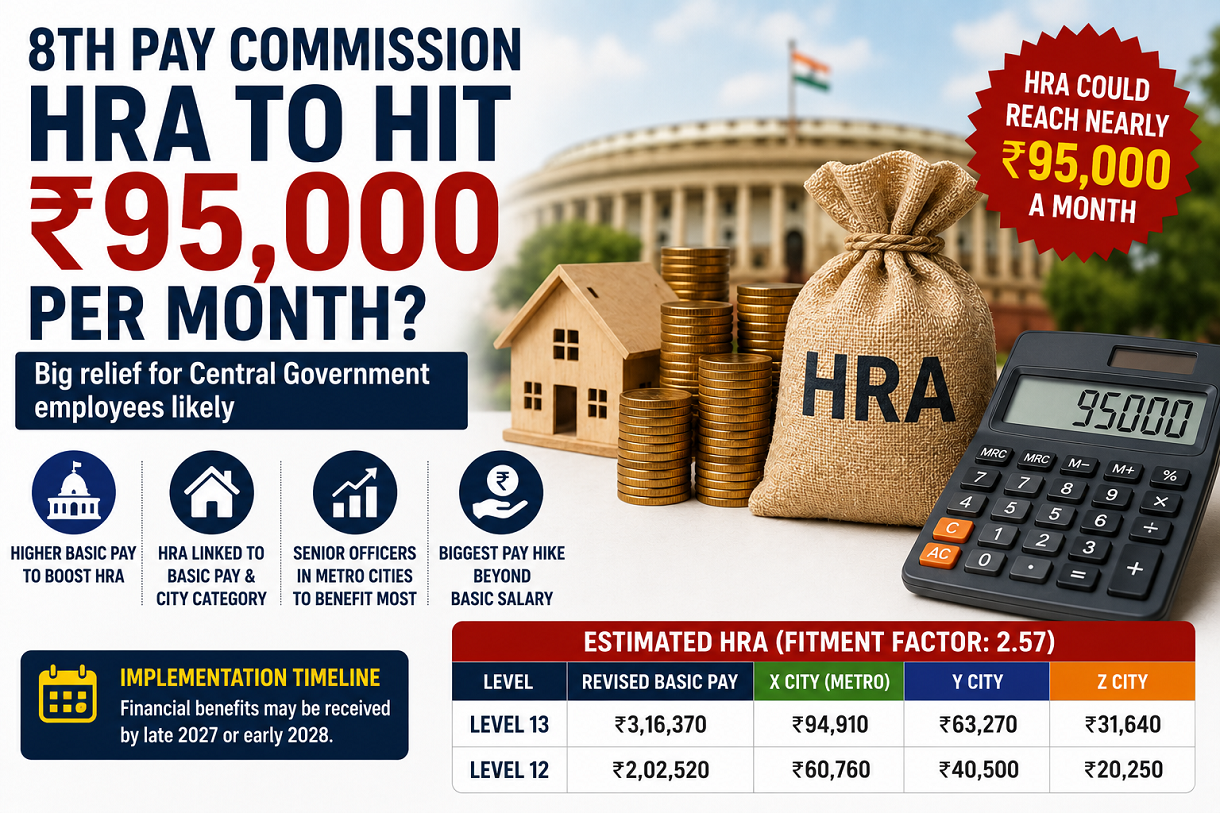
Illustrative calculations based on a fitment factor of 2.57 indicate that senior officers could receive substantially higher HRA after pay revision.
Level 13 Officer
-
Current Basic Pay: ₹1,23,100
-
Estimated Revised Basic Pay: ₹3,16,370
Estimated HRA:
-
Metro (X City): Around ₹94,900 per month
-
Y Category City: Approximately ₹63,300 per month
-
Z Category City: Around ₹31,600 per month
Level 12 Officer
-
Current Basic Pay: ₹78,800
-
Estimated Revised Basic Pay: ₹2,02,520
Estimated HRA:
-
Metro (X City): Around ₹60,700 per month
-
Y Category City: Approximately ₹40,500 per month
-
Z Category City: Around ₹20,200 per month
These figures are based on estimated calculations and do not represent official government announcements.
Is a Minimum Basic Salary of ₹69,000 Realistic?
Social media discussions have widely circulated claims that the minimum Basic Pay under the 8th Pay Commission could increase from ₹18,000 to nearly ₹69,000.
The estimate is based on employee unions' demand for a fitment factor of 3.83, which would produce:
₹18,000 × 3.83 = ₹68,940
However, financial analysts believe this scenario may be difficult to implement because the government must also consider several macroeconomic factors, including:
-
Fiscal deficit
-
Public expenditure
-
Defence spending
-
Welfare schemes
-
Inflation trends
-
Overall budgetary capacity
For this reason, many policy experts expect the eventual fitment factor to remain somewhere between 2.0 and 2.6, resulting in a more practical minimum Basic Pay in the range of ₹36,000 to ₹52,000, depending on the final recommendations.
Final Outlook
The 8th Pay Commission has the potential to significantly increase the earnings of Central Government employees through higher Basic Pay and corresponding allowances such as HRA. However, the actual salary structure, fitment factor, and implementation timeline will only become clear after the Commission submits its recommendations and the government formally approves them.
Until an official announcement is made, all salary projections—including estimates of HRA reaching nearly ₹95,000 per month—should be viewed as analytical estimates rather than confirmed government decisions.