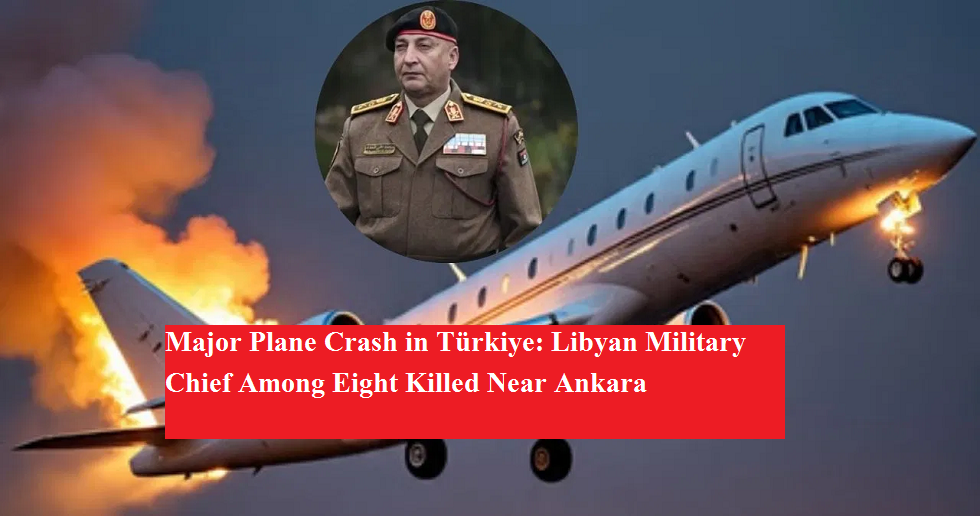
A major aviation tragedy has shaken Türkiye after a private jet carrying senior Libyan officials crashed near the capital, Ankara, killing all eight people on board. Among the victims was Libya’s top military chief, Mohammed Ali Ahmed Al-Haddad, making the incident a significant blow not only to aviation safety but also to Libya’s political and security landscape.
The crash triggered panic in the region and led to the temporary closure of Ankara’s Esenboğa Airport, with several flights diverted to alternate destinations. Turkish and Libyan authorities have confirmed that there were no survivors.
What Happened: Timeline of the Crash
According to officials, the accident occurred on Tuesday evening, shortly after the aircraft departed from Ankara’s Esenboğa Airport at around 8:30 PM local time. The jet, a Dassault Falcon 50, was heading back to Libya after an official diplomatic visit.
Approximately 40 minutes after takeoff, air traffic control lost contact with the aircraft. Before communication was completely cut off, the plane reportedly sent an emergency landing signal near Haymana district, located south of Ankara. Moments later, residents in the area noticed a bright flash in the sky, raising alarms and prompting immediate action from security and rescue agencies.
Wreckage of the aircraft was later recovered near Ankara, confirming the worst fears.
Who Were on Board the Aircraft
Libyan Prime Minister Abdul Hamid Dbeibeh officially confirmed the deaths and described the incident as “tragic and deeply painful for the nation.” The private jet was carrying:
-
Mohammed Ali Ahmed Al-Haddad, Libya’s Military Chief
-
Four senior Libyan military officials
-
Three crew members
All eight occupants lost their lives in the crash.
The Libyan officials killed in the accident included:
-
Al-Fitouri Ghrabil, senior officer
-
Brigadier General Mahmoud Al-Qatwani
-
Mohammed Al-Asawi Diyab, adviser to the Chief of Staff
-
Mohammed Omar Ahmed Mahjoob, military photographer in the Chief of Staff’s office
Possible Cause: Technical Failure and Bad Weather
Initial assessments by Libyan authorities suggest that the crash may have been caused by a technical malfunction, potentially worsened by adverse weather conditions. While poor visibility and unstable weather are believed to have played a role, officials have clarified that a full investigation is currently underway to determine the exact cause.
Turkish Interior Minister Ali Yerlikaya confirmed the timeline of the incident and said that emergency response teams were deployed immediately after contact with the aircraft was lost.
Ankara Airport Temporarily Shut, Flights Diverted
Following the crash, Ankara Esenboğa Airport was temporarily closed as a precautionary measure. Several domestic and international flights were redirected to nearby airports. Normal operations resumed later after safety checks were completed.
The incident caused significant disruption to air traffic and heightened security across the region.
Why This Loss Is Significant for Libya
Mohammed Ali Ahmed Al-Haddad was considered one of the most influential military figures in western Libya. He played a key role in United Nations-backed efforts to unify Libya’s fragmented military structure, which has long been divided amid political instability.
On the day of the crash, Al-Haddad had held meetings with Türkiye’s Defence Minister Yaşar Güler and other senior Turkish officials. The visit was seen as part of broader diplomatic and security cooperation between Libya and Türkiye.
Libyan Prime Minister Dbeibeh called the incident a major national loss, emphasizing Al-Haddad’s importance to Libya’s security framework.
About the Aircraft: Dassault Falcon 50
The aircraft involved in the crash was a Dassault Falcon 50 (registration: 9H-DFS), a triple-engine, super mid-size business jet operated by Harmony Jets. The aircraft is registered in Malta and was manufactured in 1988.
Key features of the Falcon 50 include:
-
Seating capacity of up to 10 passengers
-
Long-range capability
-
Advanced avionics for its class
-
Onboard Wi-Fi and modern business jet amenities
Despite its reputation for reliability, older aircraft require rigorous maintenance, which will likely be examined closely during the investigation.
Ongoing Investigation and International Coordination
Turkish and Libyan authorities are working together to investigate the crash. Prime Minister Dbeibeh is reportedly in direct contact with Türkiye’s President and senior leadership, coordinating responses and next steps.
The incident is being viewed as a serious setback for Libya’s military leadership and political stability, especially given the sensitive role Al-Haddad played in ongoing unification efforts.
Conclusion
The deadly plane crash near Ankara has left both Türkiye and Libya in mourning. With the loss of Libya’s military chief and several high-ranking officials, the tragedy goes beyond aviation and enters the realm of regional security and diplomacy. As investigations continue, both nations await answers while paying tribute to the lives lost in one of the most serious aviation incidents involving foreign officials in recent times.