NATIONAL
PM Modi Announces GST Reduction Ahead of Diwali: Essential Goods to Become Cheaper from October
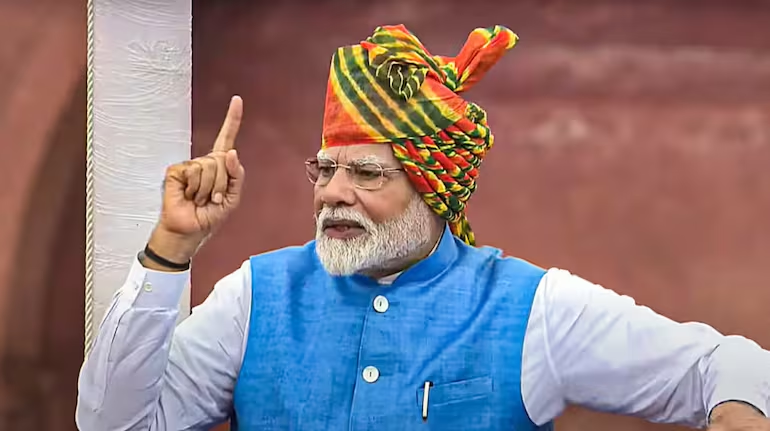
Prime Minister Narendra Modi has announced a major reform in the Goods and Services Tax (GST) regime, promising relief to millions of consumers ahead of Diwali. Addressing the nation from the Red Fort on Independence Day, the Prime Minister revealed that the government will implement the second phase of GST reforms in October 2025. This move is expected to lower prices of essential goods and provide significant relief to households grappling with inflation.
A Festival Gift for Consumers
The Prime Minister assured that the upcoming festive season would bring “double joy” for citizens, as GST rates will be rationalized to make everyday items more affordable. According to Modi, this reform will not only reduce household expenses but also benefit small and medium enterprises (MSMEs) by lowering their operational costs.
“Over the past eight years, we have eased the tax burden on the country and simplified the tax system. This Diwali, the next phase of GST reforms will be rolled out,” Modi said during his address.
Background on GST Reforms
Introduced on July 1, 2017, GST was hailed as one of the biggest tax reforms in India, replacing a complex web of state and central taxes with a unified system. Over the years, the government has continuously worked to refine the system. GST decisions are made by the GST Council, headed by Finance Minister Nirmala Sitharaman and comprising state finance ministers.
The Council had earlier set up a Group of Ministers (GoM) in September 2021 to review GST rates. Based on the GoM’s recommendations, the government is now preparing to reduce the number of GST slabs from four to three. Currently, goods and services fall under 5%, 12%, 18%, and 28% categories. The 12% slab is likely to be removed altogether.
Impact on Prices and Economy
Officials indicate that the reduction will focus on goods of daily necessity, leading to a notable dip in prices for essential commodities, including food items. Economists believe that this will boost domestic consumption, offsetting any potential slowdown caused by external factors such as trade tariffs.
In recent weeks, reports have suggested that the move may also be part of India’s strategy to counter possible economic shocks from U.S. trade measures. U.S. President Donald Trump has announced a 50% tariff on Indian goods, a decision that could impact India’s GDP by 0.5%. By stimulating domestic consumption through lower GST, the government hopes to cushion the blow.
Upcoming Deliberations
A key meeting of the GoM, chaired by Bihar Deputy Chief Minister Samrat Choudhary, is scheduled for next week to finalize the revised GST rate structure. The Prime Minister’s Office had already approved the broad reform plan in July. If implemented as expected, the changes will take effect in October, just weeks before Diwali.
Relief for Lower-Income Households
Economic analysts stress that the biggest beneficiaries of the GST cut will be lower-income groups, as reduced tax on essential goods will directly lower their monthly expenses. The government has already provided relief to the middle class by making annual income up to ₹12 lakh tax-free, increasing disposable income for millions of families.
By reducing GST on essential commodities, the government aims to ease inflationary pressures, strengthen household purchasing power, and ensure a more cheerful festive season for consumers across the country.
With these reforms, Diwali 2025 is poised to bring not only lights and celebrations but also tangible economic relief for Indian households.