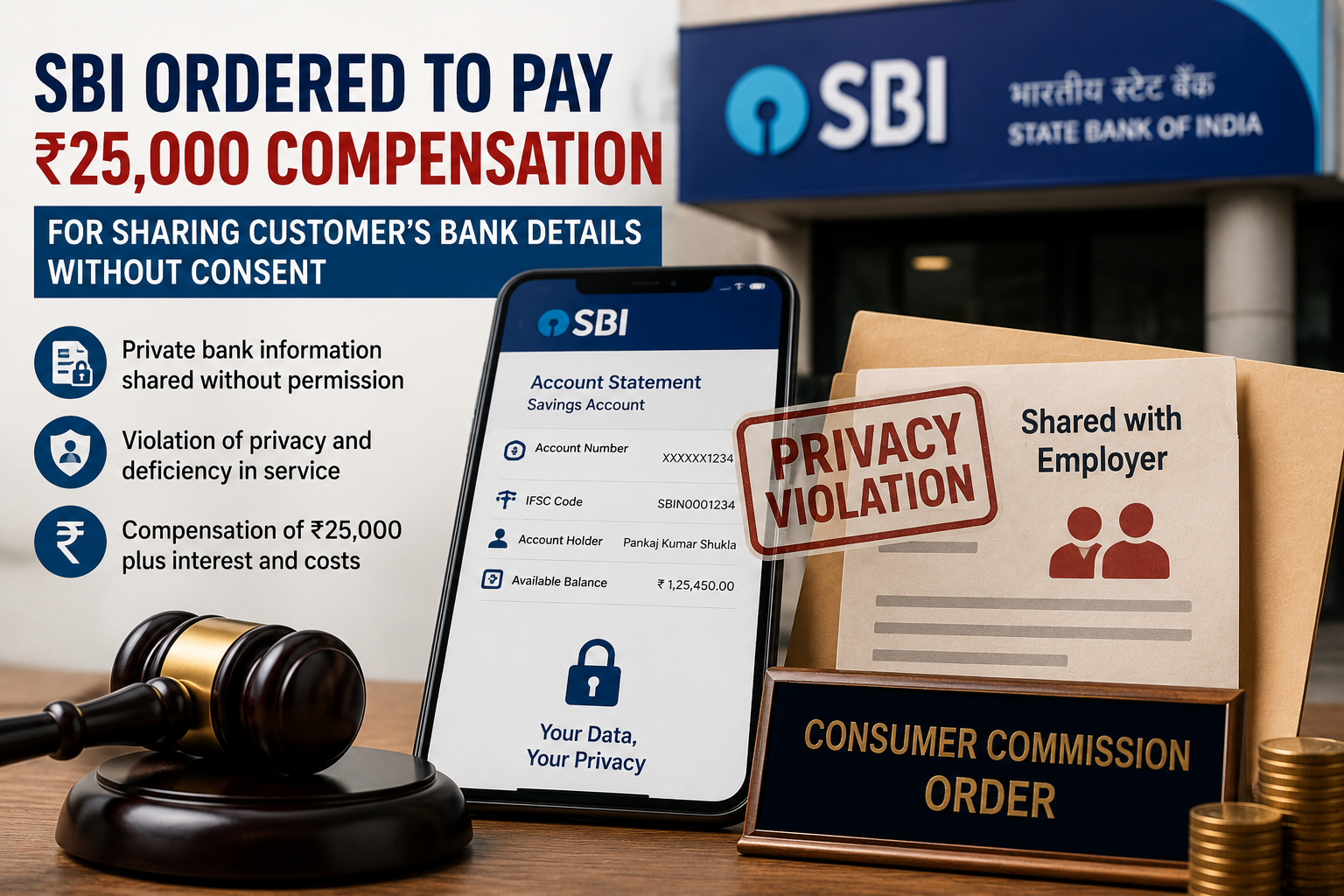
The District Consumer Disputes Redressal Commission in Lakhimpur Kheri, Uttar Pradesh, has directed the State Bank of India (SBI) to compensate a customer after finding that the bank disclosed his personal banking information to a third party without his permission. The commission held that the bank's actions amounted to a deficiency in service and violated the customer's right to privacy.
Under the order, SBI has been instructed to pay ₹25,000, including compensation for mental distress and litigation expenses, along with interest on part of the awarded amount.
Background of the Case
The complaint was filed by Pankaj Kumar Shukla, a former employee of Govind Sugar Mill. Shukla maintained a personal savings account at SBI's Hargaon branch in Sitapur district.
According to the complaint, a labour dispute between Shukla and his former employer was pending before the Lucknow Bench of the Allahabad High Court. During the legal proceedings, the sugar mill submitted an affidavit before the court that included the statement of Shukla's personal SBI savings account.
Shukla alleged that he had never authorized the bank to disclose his personal banking records to his employer or any other third party. He claimed that the disclosure caused him significant mental stress and hardship.
Allegations of Incorrect Account Entries
Apart from the alleged privacy breach, the complainant also pointed out inaccuracies in his bank account statement.
According to the case records, SBI later acknowledged certain discrepancies in the account details through a communication dated April 29, 2022, and corrected the identified errors.
However, Shukla stated that when he sought a written explanation from the bank regarding the unauthorized sharing of his account information, he did not receive a satisfactory response from the concerned branch.
SBI's Defense Before the Commission
During the proceedings, SBI argued that Govind Sugar Mill was also one of the bank's customers and that employees' salaries were processed through the bank.
The bank stated that on November 9, 2021, the employer requested the account statement for the purpose of reconciling salary records, following which the information was provided.
SBI further contended that since the labour dispute was still pending before the court, the sugar mill should also have been included as a party in the consumer complaint.
Consumer Commission's Findings
After examining the facts, the District Consumer Commission observed that the savings account maintained at SBI's Hargaon branch was a personal account belonging solely to the complainant.
The commission concluded that the account had no direct connection with the employer or the salary disbursement process in a manner that justified disclosure without the account holder's consent.
The commission emphasized that banking institutions are expected to maintain strict confidentiality regarding customers' financial information. Unless disclosure is permitted by law or authorized by the customer, personal banking records cannot be shared with third parties.
On this basis, the commission held that both the SBI branch involved and the relevant bank authorities failed to protect the customer's confidential information, constituting a deficiency in banking service.
Compensation Awarded by the Commission
The consumer commission directed SBI to pay:
- ₹20,000 as compensation for the mental distress suffered by the complainant.
- Interest at 6% per annum on the compensation amount, calculated from July 26, 2022, until the date of payment.
- ₹5,000 towards litigation expenses.
The total financial liability under the order amounts to ₹25,000, excluding the applicable interest component.
Non-Compliance Could Lead to Further Legal Action
The commission also clarified that if SBI fails to comply with the order within the prescribed period, the complainant will be entitled to initiate appropriate legal proceedings to enforce the commission's decision in accordance with applicable consumer protection laws.
Why the Order Is Significant
The ruling highlights the importance of customer privacy in banking services. Financial institutions are expected to safeguard sensitive customer information and disclose it only when legally required or with the explicit consent of the account holder.
The case serves as a reminder that banks have a legal and ethical responsibility to maintain the confidentiality of customer records, and any unauthorized disclosure may expose them to liability under consumer protection laws.
Disclaimer: This article is based on the findings and directions issued by the District Consumer Disputes Redressal Commission. The matter relates to a specific case, and any further legal proceedings or appeals may affect the final outcome.