BIZARRE
Scientists Spot a Bizarre 10-Sided Shape Over Saturn's South Pole: Hubble Captures a Mystery Bigger Than Earth
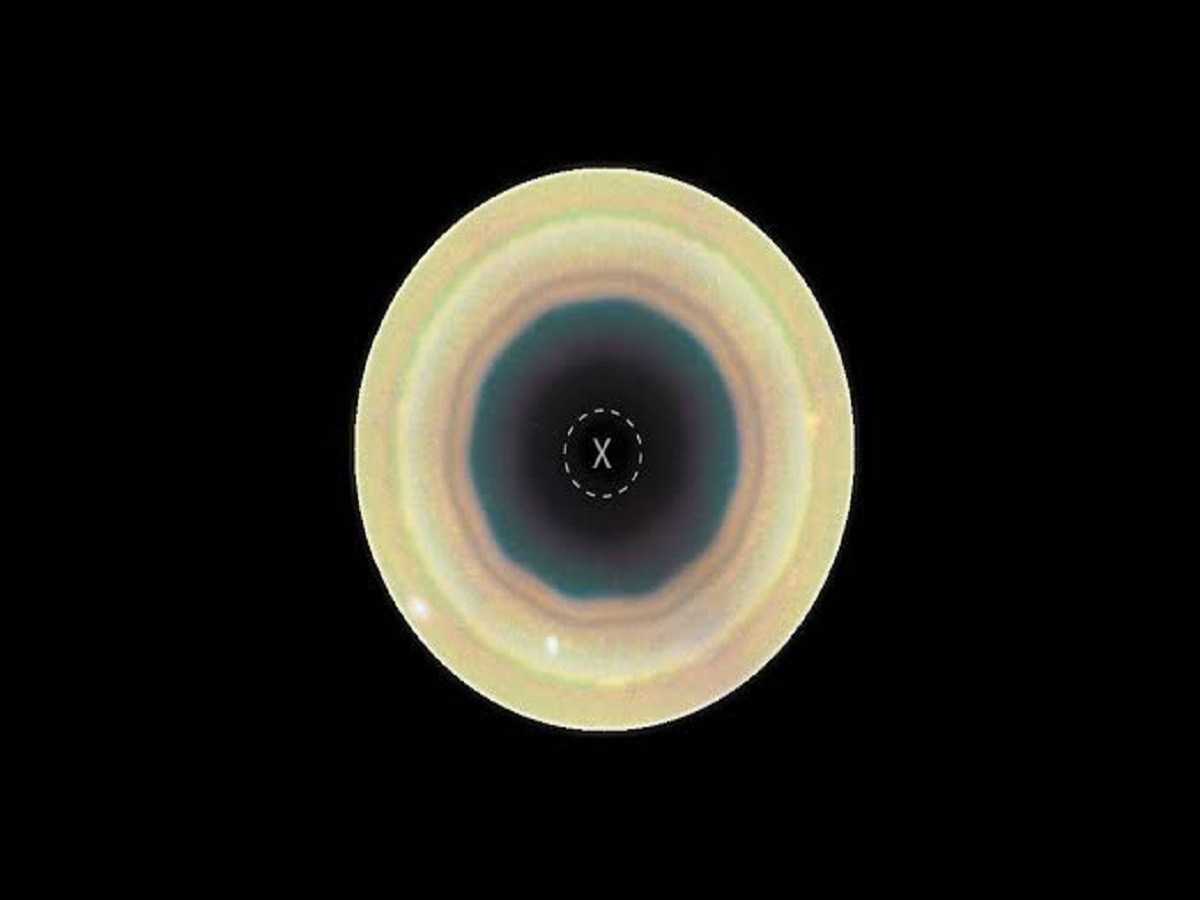
Space has once again produced something that looks almost impossible. Scientists studying Saturn have identified a gigantic 10-sided atmospheric pattern over the planet's south pole, creating a bizarre geometric shape in the clouds.
The unusual structure was spotted in observations made by the Hubble Space Telescope and has surprised researchers because Saturn is already famous for another strange atmospheric feature—a six-sided pattern around its north pole.
A giant cosmic decagon
The newly identified feature resembles a decagon, meaning a shape with ten sides. Researchers estimate that one side of this enormous atmospheric pattern stretches for more than 10,000 miles (around 16,000 kilometres).
Unlike an ordinary geometric shape drawn on paper, this structure is created by movements in Saturn's atmosphere. The planet's clouds and powerful winds can form enormous waves and patterns that are unlike anything commonly seen on Earth.
Even stranger than Saturn's famous hexagon
Saturn's north pole has been famous for decades because of its enormous six-sided atmospheric formation. The newly identified southern pattern is different.
Scientists say the southern decagon appears to be larger and more unstable than the famous northern hexagon. The southern feature also moves eastward at roughly 6 mph (10 km/h), whereas Saturn's northern hexagon remains comparatively stationary.
How did it form?
Researchers believe atmospheric waves and powerful currents deep within Saturn's atmosphere are responsible for creating these unusual shapes.
The southern pole was difficult to observe from Earth for years because of Saturn's changing seasons and orientation. Scientists believe the feature may have developed sometime between 2017 and 2023, when Saturn's southern polar region was not easily visible.
That makes the discovery particularly interesting: scientists aren't simply looking at a strange shape—they are getting an opportunity to study how enormous atmospheric structures can appear and evolve over time.
Why does this matter?
At first glance, a strange shape in the clouds may seem like little more than a spectacular space curiosity. But studying Saturn's atmosphere can help scientists understand how weather behaves on giant planets.
Researchers hope that observations of the southern decagon will reveal more about atmospheric waves, powerful jet streams and the mechanisms that create polygon-shaped weather systems.
Saturn isn't the only planet with unusual atmospheric activity, but the appearance of such precise polygonal structures makes it particularly fascinating to planetary scientists.
Saturn keeps getting stranger
Saturn has already given scientists some of the solar system's most bizarre sights, from its enormous rings to the mysterious hexagon at its north pole.
Now, the discovery of a 10-sided atmospheric structure at the south pole adds another mystery to the list.
The biggest question is not simply why Saturn has such strange shapes, but how long this newly discovered decagon will survive and how it will change. As Saturn's southern hemisphere becomes easier to observe, scientists expect future observations to provide an even clearer picture of this extraordinary phenomenon.