NATIONAL
Aadhaar and Voter ID cards cannot be considered as birth certificates: Madhya Pradesh High Court
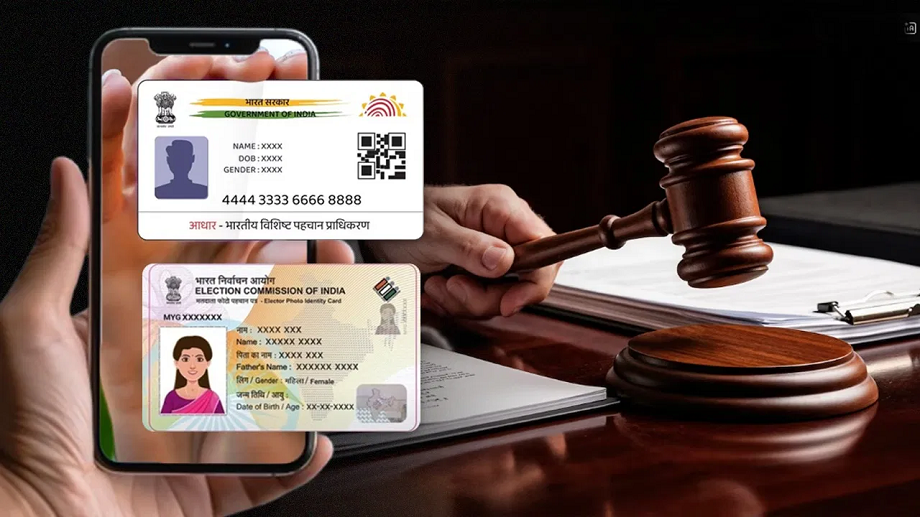
The Madhya Pradesh High Court has made a significant statement regarding Aadhaar and Voter ID cards. The Madhya Pradesh High Court stated that Aadhaar and Voter ID cards are not definitive proof of a person's date of birth. The court stated that only the date of birth recorded in an employee's service record is valid.
A written petition was filed challenging the order of the Additional Collector of Dhar district, who had granted the petition filed by Hiralal Bai (Respondent No. 5) challenging his retirement.
Consequently, Hiralal Bai was reinstated as Anganwadi Assistant and the petitioner was removed from the job as there was only one sanctioned post of Anganwadi Assistant.
According to the petitioner, she was appointed to the position of Anganwadi Assistant following a selection process in accordance with the policy guidelines issued by the Department of Women and Child Development. Her appointment order was issued in June 2018.
A petition was filed in the court
It was stated that Hiralal Bai had previously held the same position and, according to her office service records, had retired at the age of 62. Hiralal Bai never questioned or challenged this retirement order. After the position became vacant, the competent authority issued an advertisement and completed the selection process.
Hiralal Bai filed an appeal nearly two years after his retirement, claiming that his date of birth was wrongly recorded and that he was born on January 1, 1964, not March 5, 1955, as per his Aadhaar card and voter ID card.
The Court reiterated that an employee who accepts and allows the date of birth recorded in his service record to become final cannot be permitted to challenge it after retirement. The Court reiterated that in service matters, the date of birth recorded in the official service record is presumed to be correct and remains the basis for determining length of service, seniority, and retirement. Therefore, such entries must be challenged as soon as possible and supported by impeachable evidence.
The court further stated that the petitioner was never given an opportunity to be heard before the order terminating his service was passed. The bench emphasized that any administrative or quasi-judicial order having civil consequences must adhere to the principles of natural justice, especially the principle of audi alteram partem.
Therefore, the bench held that the appellate authority's order was invalid and the petitioner's termination was unsustainable. Thus, the bench set aside the impeachment orders and directed the respondents to reinstate the petitioner.