India is rapidly moving towards E100 fuel, which could reduce foreign dependence on oil. This high-ethanol fuel is environmentally friendly and promotes local production. However, this will require new vehicle technology.
India is rapidly moving towards clean and green mobility. Meanwhile, E100 fuel is generating considerable discussion. The government and automobile companies are now looking ahead to the next major step after E20, which includes higher ethanol blends. E100 is considered particularly important because it could significantly reduce dependence on traditional fossil fuels like petrol. Additionally, it promotes domestically produced ethanol, making the country less dependent on others for its energy needs and strengthening sustainability.
What is E100 fuel?
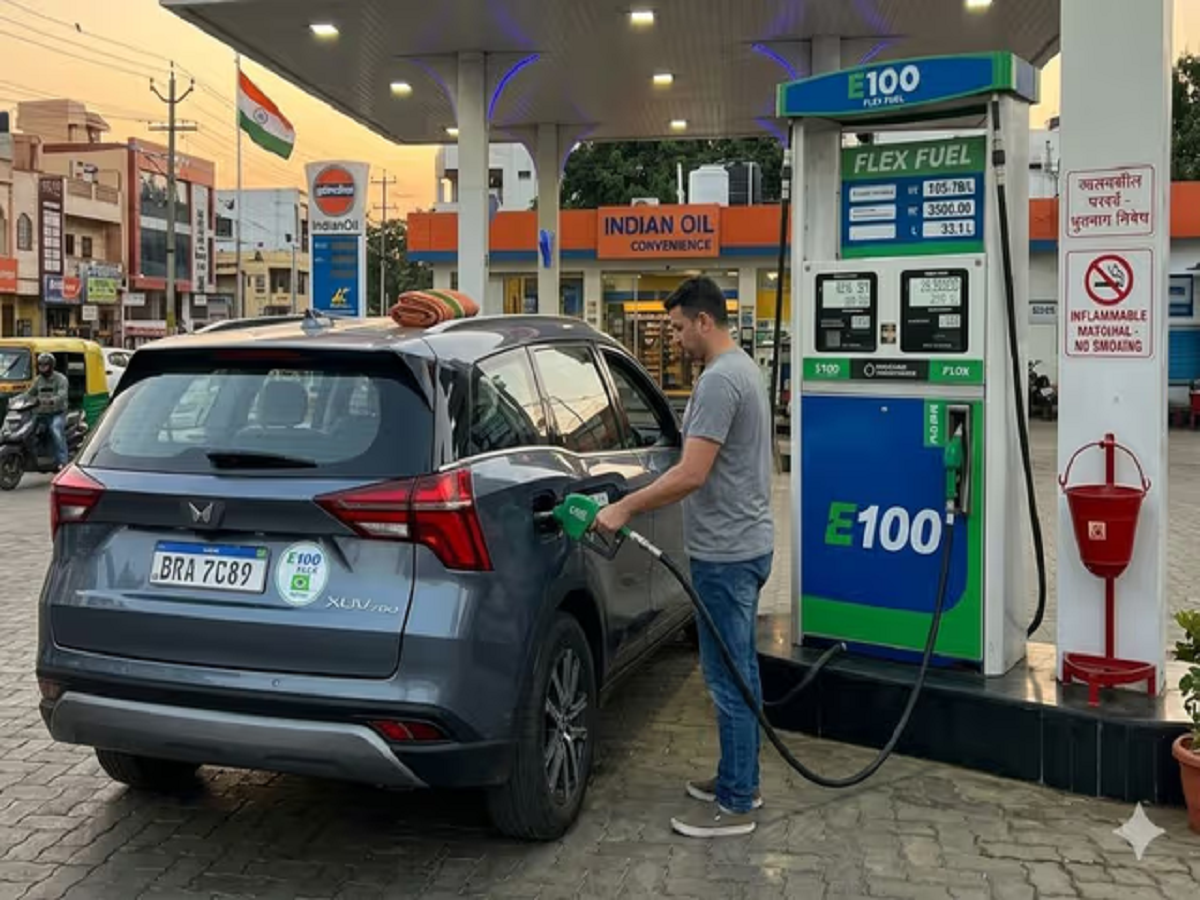
E100 is a high-ethanol fuel blend that contains almost pure ethanol. This means it can contain anywhere from 95% to 100% ethanol. The 'Ethanol 100' fuel launched by Indian Oil in India typically contains around 93-93.5% ethanol. Approximately 5% petrol and some co-solvent are also added to make the fuel more stable and perform optimally in the engine.
This fuel is specifically designed for vehicles that support high-ethanol fuels, such as flex-fuel vehicles (FFVs). These vehicles can comfortably run on different ethanol blends. Therefore, E100 is considered a better and cleaner energy option for them.
Why is E100 fuel important for India?
The primary objective behind promoting E100 fuel in India is to reduce the country's dependence on crude oil imports. According to Union Minister Nitin Gadkari, if the use of high-ethanol fuel increases, India could significantly reduce its fuel imports. Currently, the country imports approximately 87% of its oil needs.
Reducing this dependence could significantly benefit the country's economy, as India currently spends approximately 22 lakh crore rupees annually on fuel imports alone. Furthermore, ongoing geopolitical uncertainties and tensions around the world have made it clear how risky relying too much on others for energy can be.
Progress in the use of ethanol in India
India has made rapid progress in blending ethanol with petrol over the past few years. The nationwide rollout of E20 fuel was considered a major and important step. Now, the next phase is to go even further, with plans to increase ethanol blending to 30%. The government and auto sector are also promoting flex-fuel vehicles that can run comfortably on higher ethanol blends like E85 and even E100.
How easily is E100 available and how is it being used around the world?
E100 fuel was introduced in India in 2024 by Indian Oil. It was initially made available at select 183 petrol pumps spread across states like Maharashtra, Karnataka, Uttar Pradesh, Tamil Nadu, and Delhi. Globally, Brazil is the only country where E100 fuel is widely used. The situation is slightly different in other countries. For example, Sweden uses E85 fuel, while most European countries still rely on lower ethanol blends like E5 and E10.
Challenges and opportunities for automakers
The transition to E100 fuel is a major change for the automobile industry. This will require significant technology updates from car companies. Engines must be designed to handle fuels with higher ethanol content, as ethanol is slightly more corrosive than gasoline. Therefore, the strength and correct tuning of engine materials become crucial.
But this shift presents not only challenges but also opportunities. Vehicles running on fuel with a higher ethanol blend can offer better performance and sometimes even greater efficiency. Furthermore, because ethanol is produced domestically, it could also provide some relief on fuel prices in the long run, directly benefiting the public.
PC: Prabhat Khabar