INTERNATIONAL
Why are 16 countries in Europe facing a heat emergency? Why are roads melting and railway tracks twisting?
Causes of Heatwave in Europe: The intense heat in Europe is melting roads and warping tracks. But the question is: when people in India can easily tolerate temperatures of 45 degrees Celsius, why is Europe boiling over at just 40°C? Is this continent caught in a heat trap?
Adverse Effects of Heatwave in Europe: A month ago, American meteorologists predicted a severe heatwave in Europe this July, perhaps so severe that it could shatter a century-old record. That prediction has been a reality in Europe since the beginning of June. But the question is whether the heatwave will persist, or whether the situation will worsen as predicted by scientific forecasts.
Roads are melting in the heat
So far, 1,500 people have died due to heat in Europe. In 16 countries, the mercury has reached 40 degrees Celsius, and in some, it has exceeded that. This isn't the first time this has happened in Europe; heatwaves occur every 20 to 25 years. A similar period occurred in 2003. But the question is how heatwave conditions are created in a cold continent like Europe.
Why are 40-degree temperatures causing melting roads, buckling railway tracks, and people suffocating and fainting? In our Asian continent, 40-degree heat is considered normal. In fact, we can easily withstand temperatures of 45-46 degrees. So why is the situation so dire in Europe?
Europe boiling at 40+ degrees, how long will this misery last?
How much is Europe itself responsible for this heat emergency? How much of a factor is climate change altering the weather cycle? Most importantly, which regions of the world will be affected by the heat and heat waves currently raging in Europe? Understand all this in this special explainer report.
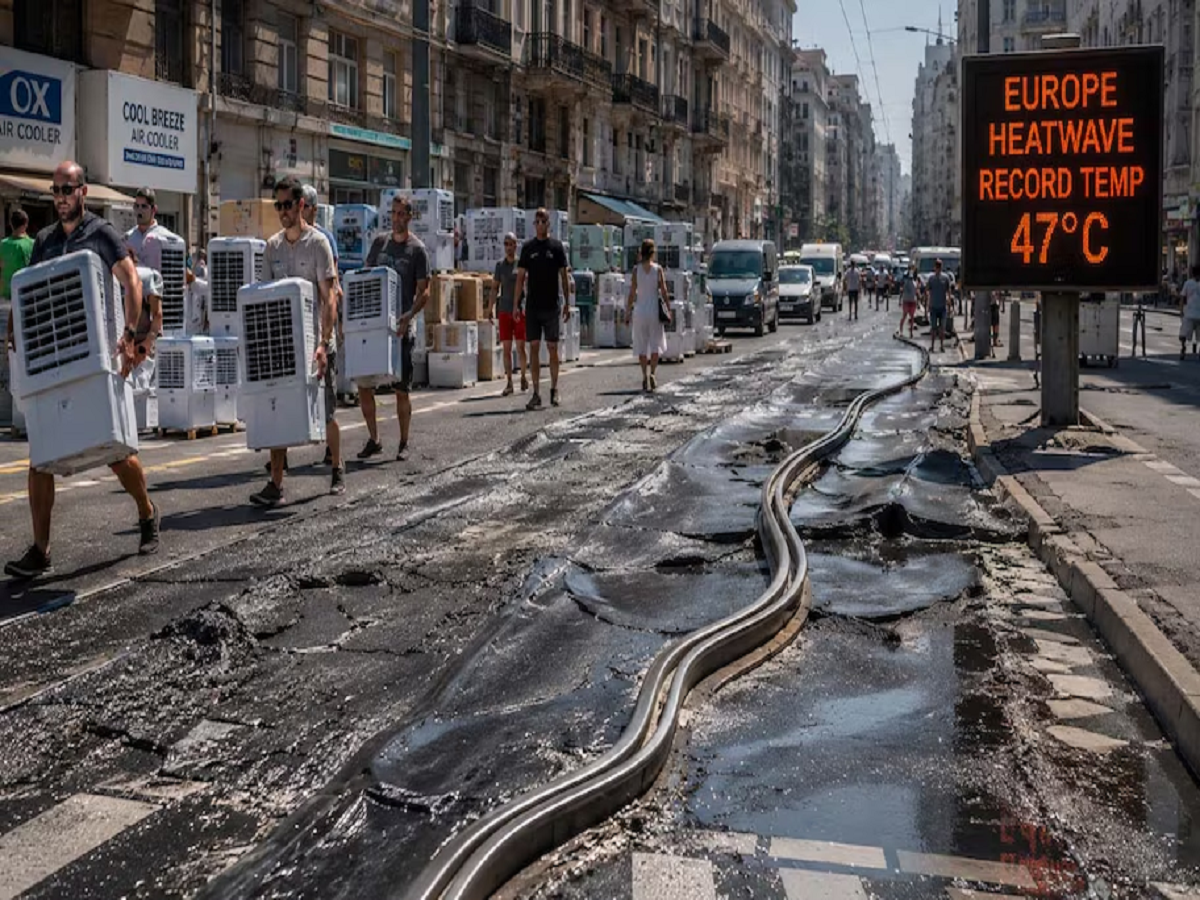
Europe, known for its pleasant summer weather, is melting under record-breaking temperatures. Road tar is melting in places. Red lights have melted and become crooked. Railway tracks are also visibly melted in some places. The heat wave has reached eastern Europe. Here, a man was seen making an omelet in a hot pan outside his balcony in the sun.
A fierce sunshine over Europe
Spain - 45 degrees
Germany - 41.7 degrees
Denmark- 37 degrees
France – 44.3 degrees
Italy – Red alert in 18 cities
Czech Republic - 40 degrees
Switzerland - 38.8 degrees
Poland – 100-year record broken
Portugal – 40 degrees above
In India, we endure temperatures of 45 to 50 degrees Celsius every summer. But why are Europeans suffering from temperatures of only 35 to 40 degrees? The heat in Europe is so intense these days that 16 countries are facing heat emergencies. European countries are not accustomed to this kind of heat.
Why are 16 European countries burning at 40 degrees?
This Sunday was the hottest day in Germany's history. People spent hours bathing in water pools and ponds to escape the heat on the holiday. But the problem was that the water in Germany's rivers and ponds had already warmed up to 28 to 30 degrees.
Europe is a cold continent, experiencing severe winters every year and generally not experiencing a summer. Temperatures rarely exceed 20-25 degrees Celsius. This is why ACs and coolers are not commonly found in homes there. Therefore, if temperatures exceed 40 degrees Celsius, it can become a dire situation.
But this time, heat records have been shattered, leading to queues for fans and air coolers. People are lining up even before shops open, as the sun blazes across Europe.
In this heatwave, governments are doing whatever they can to provide relief, such as spraying cold water fountains, to provide some relief from the heat.
Meteorologists say that the combined effects of weather conditions like the heat dome and the omega block are a major reason for the intense heat in Europe. But the question remains: why is there so much trouble at just 40-41 degrees?
But Europe's weather conditions aren't just exacerbated by temperatures one and a half times higher than normal, but also by the trapping of warm air masses over Europe. This is known as a heat dome in meteorological terms.
Trapped in the heat dome, Europe is experiencing a feeling of heat higher than the thermometer's reading. This is called "feels-like temperature," or apparent temperature.
Feels Like Temperature is how our bodies actually feel. Let's understand how dangerous it can be with some facts.
What does temperature feel like?
Our body senses air temperature, humidity, and wind speed. When the air is too humid, sweat doesn't dry and the body doesn't cool down. In this situation, our body senses a temperature higher than the one recorded on the thermometer.
Suppose the actual temperature is 35°C but the air is high in humidity, it feels like 42-45°C. Similarly, if the wind is strong in winter, the temperature may feel up to 10 degrees lower than the actual temperature.
According to experts, the heat in Europe is also making people miserable because most homes lack air conditioners. This makes it increasingly difficult for people to escape the heat. Only about 20% of homes in Europe have air conditioning. Relief from the heat in Europe won't be possible until the heat dome is removed. This requires air movement, which is currently trapped like a closed room due to various reasons. One reason for this is El Niño.
Many European countries are experiencing a tropical night, a situation where nighttime temperatures don't drop below 30 degrees Celsius. Particularly in Western and Southern Europe, there's no respite from the heat even at night. Meteorologists say this situation is exacerbated by the effects of El Niño in the Pacific Ocean.
El Niño is a climate system in the Pacific Ocean that increases ocean temperatures and warmer air moves landward, replacing colder air. This impacts Europe. Due to the worsening El Niño in the Pacific, it was predicted in April that Europe could experience severe heat waves this year. This situation is expected to worsen after June.
The third factor is climate change. Climate scientists believe that the continued use of coal, oil, and gas is causing the Earth's temperature to rise. Consequently, heatwaves are occurring more frequently and for longer periods than before.
This situation becomes even more dangerous in Europe because most countries here typically have temperatures between 20 and 25 degrees Celsius. However, when the mercury reaches 30 to 40 degrees Celsius, the risk of dehydration, heat stroke, and heart problems increases. This time, the elderly, children, and those with pre-existing medical conditions are particularly affected.
Image Credit: AI generated photo